KABLOONAS

KABLOONAS
Burial of John Franklin. Author: me

KABLOONAS

Kabloonas is the way in which the Inuit who live in the north part of Canada call those who haven´t their same ascendency.

The first time i read this word was in the book "Fatal Passage" by Ken McGoogan, when, as the result of the conversations between John Rae and some inuit, and trying to find any evidence of the ill-fated Sir John Franklin Expedition, some of then mentioned that they watched how some kabloonas walked to die in the proximities of the river Great Fish.

I wish to publish this blog to order and share all those anecdotes that I´ve been finding in the arctic literature about arctic expeditions. My interest began more than 15 years ago reading a little book of my brother about north and south pole expeditions. I began reading almost all the bibliography about Antarctic expeditions and the superknown expeditions of Scott, Amundsen, Shackleton, etc. After I was captured by the Nansen, Nobile and Engineer Andree. But the most disturbing thing in that little book, full of pictures, was the two pages dedicated to the last Franklin expedition of the S.XIX, on that moment I thought that given the time on which this and others expeditions happened, few or any additional information could be obtained about it. I couldn´t imagine that after those two pages It would be a huge iceberg full of stories, unresolved misteries, anecdotes, etc. I believe that this iceberg, on the contrary than others, would continue growing instead melting.


viernes, 29 de diciembre de 2017

THE FORGOTTEN GRAVES - ABDUCTING INUIT PEOPLE CHAPTER I

Along the history of polar exploration and whale hunting, Inuit people have been taken away from their birth places by their far "neighbours". Whalers, alike, exploring expeditions abducted Inuit hunters, and also women and children, sometimes purposedly by force, and sometimes kindly when rescuing them, during their homeward trip, from the sea when they had got lost fram from the coast. This, is the first chapter of a series of cases I wanted to analyse in my blog.

Maybe, one of the more dramatic depiction of such practices I have ever read is that of Nordenskjold in his article "Eskimos, Ancient and Modern", which expresses vivid and tragically how these events used to happen through a particular case, to which I will come back in the coming chapters:

"Their meetings always ended in the murder or capture of the poor natives, who were carried away to be shown as curious animals in Europe. La Peyrere's Report of Greenland, written in 1647, describes them, and goes on to tell of the nine Eskimos who had been brought to Denmark by different Polar expeditions. Poor Eskimos ! They often looked northwards, and once tried to escape in their skiffs ; but a storm cast them ashore, and some peasants caught them and took them back to Copenhagen. Two of them again tried to escape in their kayaks ; one was caught, the other who got away was drowned at sea. The last of them died of grief after the failure of his third attempt to return to Greenland in his kayak. He was thirty or forty miles out to sea before he was overtaken." 

And this, unfortunately, is a tale which is repeated along the time invariably, there usually weren´t survivors, as we soon will see. Inuit people who arrived to Europe, hardly ever got used to the insane atmosphere of the British cities, their local illnesses, or maybe, they just couldn´t stand the very different diet they were obliged to follow.

Maybe the most well documented of these events, and likely one of the first, is the case of Calichoughe (or Kalicho), a woman called Ignorth (or Egnock), and her child, Nutaaq (or Nutioc)., who were got caught prisoners in 1577 by Martin Frobisher. It has inspired some articles and the story appears here and there everywhere and it is not the  main subject of this post. The three Inuit people where nicely portrayed by talented artists of the time, like John White or Cornelis Ketel, author of several paintings (some of them in their Inuit clothes, other dressing like Englishmen and others naked, and which apparently haven´t survived). The existing portraits by John White are held in the British Museum.
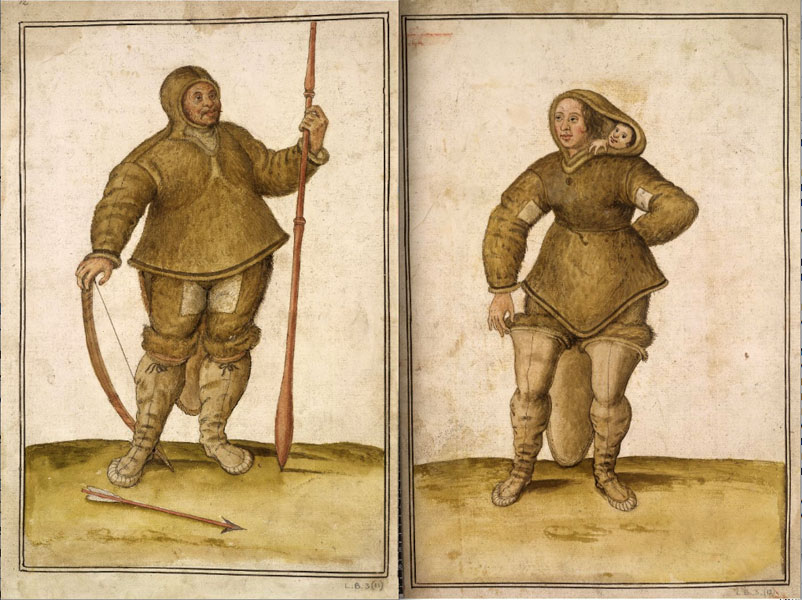

Kalicho, Ignorth and Nutaaq by John White
The corpses of the two adults were properly authopsied and then, after, buried  in St Steven´s church (or St Stephen´s) in Bristol in november of 1577. Nutaaq, who died time after in London, on his way to "visit" the Queen, was buried in St Olave´s church before that happened 

The sixteenth century sailor and pirate, Martin Frobisher, led three expeditions to the Arctic, his first intention was to find the mythical Northwest passage, but after stumbling upon Baffin island and with the deep bay which nowadays bears his name, he subsequently focus his attention on those shores and  forgot the searching of the passage on behalf of exploiding the imaginary treasures he thought Frobisher bay hide. It was during those expeditions when he contacted local Inuit tribes which lived there.

His first contact, was during the 1576 expedition to Baffin´s bay, when inside Frobisher´s bay, in Burche´s island, he found some Inuit men who were asked to guide the expedition, Frobisher sent five men in a boat to deal with them but they apparently were caught captives. Then, in his turn, Frobisher captured one Inuit man as a hostage. 

This man was taken to England and reached London, where he soon died. As it is said in the article "Frobisher Eskimo´s in England" of "colde which he had taken at sea" hardly three weeks after landing. He was portrayed post mortem by Cornelius Ketel (I couldn´t find this particular one cause it also is part of the Ketel´s lost collection of Eskimo paintings). His body was embalmed, apparently with the idea of sending back him to his country and a wax face mask was also allegedly made. His body never reached Baffin island but was buried in St. Olave's churchyard, behind its sinister door which is decored with three smiling skulls, in Hart street, London. 

This particular church, it is a survivor itself, an ancient rarety which survived the great fire of 1666 and the war bombings of 1941. It has been sieged by tall buildings and busy roads since it was built many centuries ago. But now, who knows what´s left of the old churchard and if the bodies of this poor man and Nutaaq (who as we read above, was also buried here) are still there and there weren´t forcedly and violently exhumed because of the german bombs dropped during the WWII. There are no records of these two burials nor gravestone which indicate their bones are still there. 
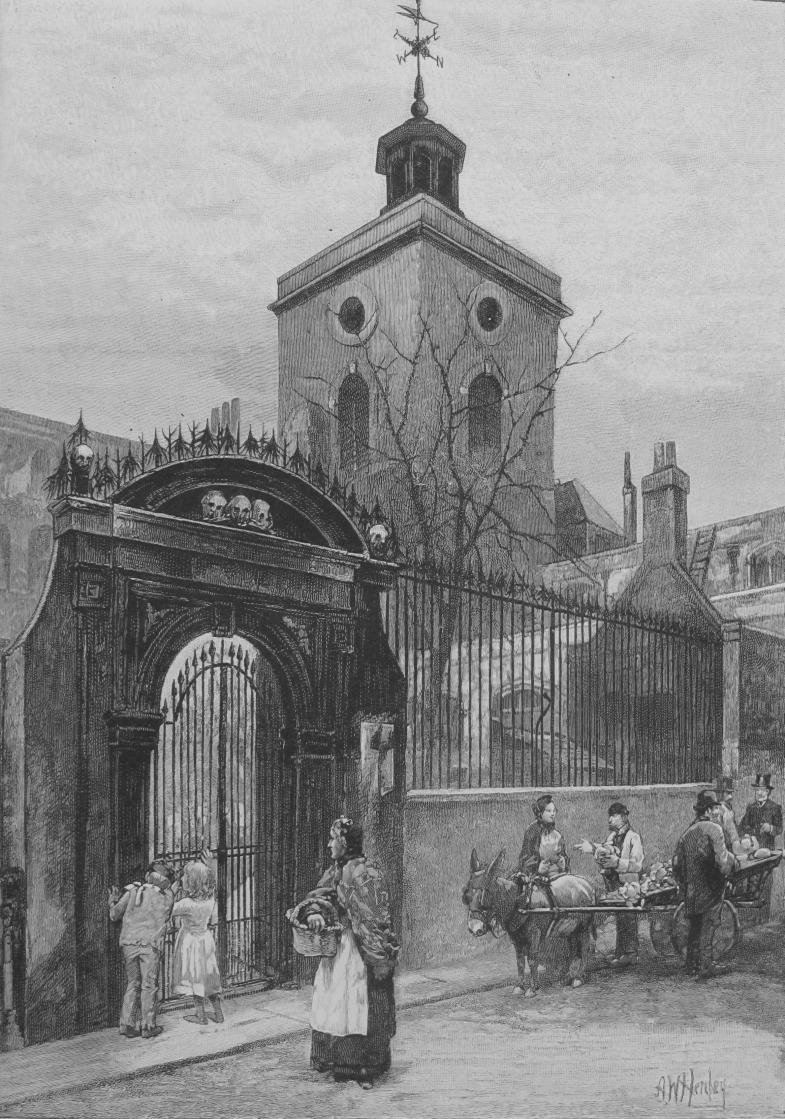

St Olave´s church, London
There are plaques in these churches which honour prominent people of the time, in fact St Olave´s church was at that time a very honourable place to be buried, in spite of the fact it is also the place of burial for a pantomine character like Mother Goose. St Stephen´s church, which was at that time well located at the bank of the river, also was a place of certain importance which witnessed many departing merchant ships. So it looks that the abducted Inuit people actually were treated with big honors at the time of their final voyage, thing which is underlined by the fact that, though they weren´t christians, unusally for that time, there is a record of the two St Stephen´s  church  burials. The register says what follows:

"Collichang a heathen man buried the 8th of November. Egnock a heathen woman buried the 13th of November'''

In St Stephen´s church, there also seems to exist a gravestone which marks the burial place. The stone reads:

"Where rest ...two In... (inuit? Indians? Inuk?) kidnapped from Baffin Island (?)"

http://www.drawingexchange.org/the-graveyard-tours/graveyard-exchanges/

It is difficult to have a clear reading of what was engraved in that gravestone, but at least we can clearly see the word "Kidnapped" on it, which seems to pay somehow the debt or at least, a last tribute, with these two people, as a sort of recognition that wanted to show to any casual visitor, that the facts which brought them to England and to  such premature death, were not gallant at all. On the other hand, if the stone is contemporary of the burials, the word Inuit or Inuk, I have believed to have read, wouldn´t have sense since the used term by that time was Eskimo. Maybe some good hearted soul decided to place this stone much later. Anyway, I would love that someone on the ground in the surroundings of Bristol could forward me a better image of this gravestone.

But still, there are no plaques or gravestones in St Olave, at least no one I could have found in the Internet.  In "Frobisher´s Eskimo" article referenced below, the decission to bury the child and the first abducted Inuit there, lies on the following:


"Was it chosen for the Eskimos because its dedicatee, the Norseman Olaf Haraldsson who was converted to Christianity in the eleventh century, was thought to be suitable numen to preside over their pagan arctic bones? The speculation is intriguing. "

For whatever reason, nowadays, we do not see any single mention of these three poor souls in almost any reference we find about both churches, St Stephen´s in Bristol and St Olave´s in London. There aren´t memorials, plaques nor anything which substantially give notice that an injustice was commited and that the silent victims of it, still are resting there.  Maybe the reason simply lies in the fact that too much time has elapsed since they were buried there and all this happened and nobody cares. Maybe they have just been forgotten and the only redoubt which calls our attention about  their final resting places is the link to st Stephen´s church gravestone before posted and those articles which talk about Frobisher´s crazy gold crusade which occassionaly talk about their graves.

They may not be recorded properly in their actual burial places but in its place, till something to mend this situation is done, I will homage them pinpointing their graves in my Polar memorials location file with the hope of any visitor of that inventory, pay someday a respectful visit to those churches to think about them, and who knows, maybe also to find and mark their graves as they actually deserve.

References: 

Frobisher Eskimos in england
The death of an Inuit man in England 
A chronological outline history of Bristol
A collection of documents of Spitzbergen and Greenland
Bristol Polar Adventures

Roanoke: Solving the Mystery of the Lost Colony


viernes, 8 de diciembre de 2017

OH RELEASE ME! OH RELEASE ME! - THE STRANGE CASE OF BENJAMIN BALLOON

Pigeons, balloons, arctic foxes, rockets, kites, tin cilinders under prominent cairns, graffitis in rocks, bottles and also golden buttons. All these were the means used by arctic expeditions for communication during those days when satellite phones simply didn´t exist. 

Many different systems, as you can see, but not all of them actually useful. Analysing and comparing their effectiveness would require a specific article, and who knows, maybe there already exists one. The more extensive description of many of them I have found, was written by Sherard Osborn in the book "Stray leaves from an arctic journal". Sherard, in a very personal witty and funny style, describes them giving you an accurate idea of what was the expectation of success they inspired at the time and how they actually worked. 

Maybe the more ingenious one, and also the more spectacular, was the inflatable balloon. These amazing inanimate messengers were made of oiled silk and were inflated with hydrogen, which was produced in site mixing zinc with sulfuric acid. Horatio Austin searching convoy of 1850, was one of the first expeditions which used these "new" inventions. At least, that is what Sherard mentions in his account of the voyage. Some of these devices were equipped with a five feet long slow match to which were attached coloured pieces of paper, or cloth, where the position of the rescuer ships was indicated. The messages were supposed to be released by the effect of that match at certain intervals  . The papers, would fall from the air with the purpose of indicating any possible survivor where to walk in search of help.

   
Sherard Osborn, complains somehow in despair while describing how almost all the released balloons from HMS Assistance flew in south or south east directions instead northwards. It was generally understood for the Admiralty at that time, and for all the contemporary searchers, that Franklin & Co. were stranded north or northwest from their current position. They thought Franklin was beset some place north of Cornwallis island or in a non existent, open polar sea even further north. If he, as Richard King firmly believed, had known that the Erebus and Terror were actually located in the vicinity of King William Island, 600 miles southwest of their position, perhaps he would have followed with his sight how  his precious balloons flew in a more correct direction than he thought with a much better mood.

It is at this point where the real protagonist of this post appear for first time. Our friend Benjamin Balloon, who was scared to death moments before being freed by a couple of s.ailors in the upper deck of HMS Assistance, as the picture in the Illustrated Arctic news shows below. 

- Oh Release me! Oh release me!.- shouted Benjamin Balloon. 

And he was.


The sad episode is told in the northern most newspaper of all as follows under the title of "Fatal Accident":

"On monday last, Benjamin Balloon, literally inflated himself from a cask containing Hydro-Gin he became light headed in consequence, and falling into a current of air, soon disappeared from the sight of the astonished spectators.

He is supposed to have on his papers to a great amount. Active steps will be taken for their recovery, they being for the most part drafts at sight of the firm of Messrs Cask and easel, of Cape Hotham and leopold."

Our indulgent Benjamin, obviously lost almost inmediately his way, taken with him forever those drafts in the wrong direction. You can read the original publication here, (page 28 of the document).

Many of those passenger-messages luckily survived that era of creativity and can still be found in some museums and in the mists of the Internet here and there. 
Message
https://www.adams.ie/catalogue_images/7034/large/313.jpg 


But, what if Franklin had been equipped with such  modern invention? had they been able to find the needed help? In fact, as I said some time ago in other of my posts, a balloon, allegedly procedent from his expedition arrived at England in 1851. A mysterious and urgent mesage was written on it indicating the position of the ships. A message which read like that:

"Erebus, 112 W, Long, 71 deg. N. Lat. September, 3, 1851. Blocked in"


The Admiralty shouldn´t lose a second and inmediately send a fleet to that place, but...it happens that, as Russell Potter correctly indicated in his post about the topic, that Franklin was never supplied with those wonderful objects, so, apart of many other aspects which play against the veracity of the theory that defends that a balloon could have reached England after flying more than three thousand kilometers, there is the undisputed  fact that there weren´t balloons on board the Erebus nor the Terror. That converts the suggestive finding into a complete and cruel hoax.


An amazing distance to be covered by an object which proved record of longest distance covered at the time and at those latitudes, was not more than 50 miles. That wasn´t the case of the carrier pigeons, which had been used for very long time as very effective messengers, though not in the arctic. A couple of pigeons were sent by John Ross from Cornwallis island during 1850. Instead of freezing, died of hunger or being shot, they reached his house in Scotland five days after being freed. That was a record never to be beaten for any other kind of messenger used in the polar regions.  Ross message, however, was not addressed to reach Franklin, but had a less trascendental purpose, it borne instructions regarding finantial  personal  matters.

Sometimes, both systems, balloons and pigeons were put together in order to optimize the benefits procured for them. A pigeon embarked one of these balloons to be carried for it, at some distance  from the ship, before being released during the flight. Ultimately, Salomon Andree also combined these two methods, though this time it was he and his friends the ones to embark in a huge balloon.  In his way to the north pole, he sent some pigeons to carry his messages homeward, thing which their feathered companions performed perfectly well for some time. At least, before Andree and company disappeared for the following thirty years before being found death in a lost and icy island. 

Another formidable method, nor for its effectiveness, but for the merriness it provoked during the short winter days of those arctic expeditions, were the arctic foxes. Those little and astute animals were fitted with copper collars on which were engraved the position of the searching ships.

Copper collar fastened on neck of fox-cub caught and released by crew of H.M.S. Enterprise, at Port Leopold, 1848

Sherard Osborne describes very visually the event of freeding a fox as follows:

Lastly, we carried out, more I believe from amusement than from any idea of being useful, a plan which had suggested itself to the people of Sir James Ross s expedition when  wintering in Leopold Harbour in 1848-49, that of enclosing information in a collar, secu-red to the necks of the Arctic foxes, caught in traps, and then liberated. Several 
animals thus entrusted with despatches or records were liberated by different ships;but, as the truth must be told, I fear in many cases the next night saw the poor " postman," s Jack facetiously termed him, in another trap, out of which he would be taken, killed, the skin taken off, and packed away, to ornament, at some future day, the neck of some  fair Dulcinea.
I can´t avoid smiling before the Quixotic reference, surely it didn´t escape Osborne the similarity between their activities and our national paradigm of uselessness. The thing is that once released, the foxes fell into the sailor traps once and once again, such was the problem that even an order had to be issued not to kill any fox taken alive in the traps, just in case they could be bearers of the messages. Of course, after the order was delivered,  all the  trapped foxes which were trapped, were "found" invariably dead. In any case, those should be scenes which many of the readers and the author of this post, would have liked to witness:

The departure of a postman was a scene of no small merriment : all hands, from the captain to the cook, were out to chase the fox, \vho, half frightened out of its wits, seemed to doubt which way to run ; whilst loud shouts and roars of laughter, breaking the cold, frosty air, were heard from ship to ship, as the fox-hunters swelled in numbers from all sides, and those that could not run mounted some neighbouring hummock of ice, and gave a view halloo, which said far more for robust health than for tuneful melody. 

Another easy way, but maybe not very effective, method of communication was carving messages in conspicuous stones which usually called the attention of any visitor. Not used normally to deliver messages to other expeditionaries, but more often used as markers of the new conquered territories. That is the case for example of Parry´s stone of Winter Harbour. A stone which would play a very important role many years after, as we soon will see.
Parry rock
Rockets and kites of different colours and numbers, were also used to send messages. But were not intended to communicate with lost explorers but with neighbour ships. Kites were supplied  to HMS Assistance by Mr Benjamin Smith, that´s what Sherard Osborne says. Was this Benjamin the British politician? Was he an ardient lover of technological and flying devices? Was after him, in his honour, that our beloved Benjamin balloon was named? Surely it was. I have tried to dig a little about his life and bizarre interests but could find at the time I wrote this post.

But the more effective way to deliver a message, even if years had passed since it had been written, buried and ultimately found, were the sealed tin cilinders inside of which, rolled papers were placed. Those time capsules, were buried under huge cairns of more than six feet tall located in strategical geographical points. It weren´t few times these tins were succesful in transmitting the intended messages. Narratives of the time speaks of them being opened and sealed again a good number of times. Sometimes, they played crucial roles. Thanks to these methods, HMS Investigator crew was rescued when one of the Kellet rescue parties found the message left by McLure at the feet of the above mentioned Parry´s stone. And it was also thanks for those magical metal cilinders, the Victory point record, that we know the few things are now known about the proceedings of the Franklin expedition before disappearing forever.

We don´t know yet if any of these messages, which were hundreds, finally reached the Franklin expedition, maybe one of them deliberado by our Benjamín balloon.... Finding any of these messages, whatever was the method followed to send them, among the belongings left by the crews of the Erebus and Terror in King WIlliam Island, would have helped to know till what year they could have survived. 

Perhaps, the current searching of the shipwrecks could help us to know if any of these messages finally reached their destination. Finding one of those coloured and typed papers on board, among the remains present in the ships will help us, not only to know if the Franklin men survived as long as the year 1850 or even after, but also to know if the ships were actually remanned or not. 

jueves, 19 de octubre de 2017

THE PARTY GOES ON: DR. JOHN RAE IN FUR A DAGUERROTYPE BY BEARD (EDITED)

I never thought I could find so many new pictures, not only pictures but Daguerrotypes!, in such short time. This time I am proud to announce I have found a beautifully coloured daguerrotype of Dr. John Rae dressed in his arctic outfit, apparently took in 1849, after returning from his overland voyage with Dr. Richardson. At least I had never seen this before now.


John Rae in arctic fur -
Silver Shadows - Fine Early photographs
There is a naughty smile in his face which suggest he was having fun or a good time while dressed like that in the photographic study. Interestengly one of the several streets, surely the locations of the different studies belonging "Beard´s photographic Institutions", is King William Street. It would be a curious and paradoxical coincidence that Rae had been pictured in that precise place. 

This picture had to be taken soon before Beard when bankrupt in 1850, a pity, because if he had overcome his finantial issues, maybe we could have now many more faces, in colour, of those heroic explorers who we could look at their eyes. 

EDIT: After the convincing comments of some heavyweights of the matter who projected founded doubts about the portrait belongs to John Rae, I have cooked a new theory. Maybe this man is James Clark Ross after all. I have made a quick "Photoshop" to compare the man in the daguerrotype with Ross´s face. Judge yourself:


For me the nose is very similar, if not in the James Clark ROss painting I used , it is in other paintings of him. Only his eyes look different, but as I said in the comments below, maybe J.C. Ross was somehow exhausted after the long winter of 1848-49 and that provoked that languish look. 

miércoles, 18 de octubre de 2017

THE DR JOHN RICHARDSON AND THE REASON WHY YOU SHOULD NEVER CEASE SEARCHING

This is going to be a short post, I can assure you that. As I asserted in my last blog publication, we never should stop searching for new pictures of our beloved and ancient explorers. I can guarantee you all, that I have performed multiple searches in the Internet trying to look for a more contemporary portrait of John Richardson, the Naval surgeon who accompanied John Franklin in his first  overland expedition, and whose role in it saved likely the life of John Hepburn, the faithful sailor, and maybe the life of Franklin as well. 

And what is what I have found?, a new and overexposed photograph of an aged John Richardson, likely shot at the last stages of his life. Richardson died at the age of 78 years old in 1865, so either the portrait was taken at about that age or was taken when he retired from active service at the age of 68. I would like to know who took this picture and why was it taken.

Dr John Richardson
Picture from Future museum
For those less familiar with his life, I will summarize here that John Richardson was an exceptional man, not only known for his arctic explorations, he participated in the Franklin´s first and second overland expeditions and in one of the first searching expeditions organized to find the lost Franklin in 1848, but also for his contributions to naval surgery and science.

His later work in the Harslan hospital, where he worked for some time together with William Edward Parry, consist on part, on training the surgeons who would join arctic expeditions. 

No matter how harsh his gesture could seem to you on this, or in other similar portraits of him, his achievements  speak of him in a very friendly way. You can read all the details in the brief biography of the Dictionary of Canadian Biography. He stood out over the average men of his time in the three different disciplines mentioned above.  He engraved every stepp of his three different careers in the path of history. As an arctic explorer, he demonstrated outstanding phisical conditions, as a surgeon he achieved so many big things which would need a whole book to explain them all, and as a naturalist, his published work speaks for itself, he rubbed shoulders with the most prominent scientist related with that matter of his time. But on top of that, he demonstrated with his actions in moments of extreme danger at the very edge of complete disaster, that he was an extraordinary and well natured human being.

You can find other portraits of him here, our large and growing collection of portraits and pictures of Arctic and Antarctic explorers. This project consists on a pinterest board, a cooperative project where, mainly Stephen Nicholson and me, are contributing to put faces to all those heroic explorers. 


lunes, 14 de agosto de 2017

LOOKING AT THE EYES OF THE FRANKLIN EXPEDITION

Encouraged by the finding, by a member of the Franklin expedition facebook group, of a portrait of William Mogg, a fairly unknown veteran of two arctic expeditions, I have recovered my interest in one of the main hobbies I practiced when I got hooked by the mistery of the Franklin expedition. This particular hobby was typing in "Google images" the names of the explorers which participated in the Franklin searching parties, and other related expeditions. Among those names, from time to time, I typed randomly the names of some of the participants of the Franklin expedition to see if any portrait of them shows up.

In order of not losing it forever again in the mists of the Internet, I began to compile those rare portraits of George Back, John Rae, John Ross, William Parker Snow, etc. in a Pinterest board, which allows you to pick up whatever image you want from the virtual world without the need of uploading it. Since a year or so, this is a cooperative project where some people are kindly adding new pictures:

https://es.pinterest.com/andrsparedes/arctic-and-antarctic-explorers/

My fishing in Google was focused mainly on the officers of the Franklin expedition, thinking that the chances they had of having been protrayed would be higher. Till now I have never been lucky. At the beginning, I wasn´t very confident that sailors could have any available portrait but it is my understanding that not ordinary men participated in those kind of coveted expeditions. I thought that some of those anonymous men could not only have been experienced sailors who had been already sailing with the officers of the expedition, but also recommendations (surely far relatives) of prominent people of the time. If you scratch a bit in the lifes of the more known seamen which participated in such expeditions, you will notice inmediately that there was always a healthy uncle or a rich family friend who surely granted a position for them in the exploration´s ships. That would increase the chances that some silhouette or small portrait of them could finally appear. Many of them, surely were ordered being made right before departing.

Maybe, now that the facebook Franklin group counts with more than one thousand and one hundred members, if some of its participants decided to join this weird hobbie of mine, new faces will give life to those names and surnames of those of our beloved 128 men who doesn´t have a face yet.

Some faces are coming from facial reconstructions made from the skulls (here too) found in King William island, but we will never now the accuracy, or even the actual identity, of those works if there aren´t pictures or portraits with which compare them. Shall this branch of the science should test its results making some facial reconstruction of people from which we already known know how their faces actually were?. I have the feeling that a reconstruction of John Irving´s skull will give us the face of Franklin...

Here there are another kind of facial reconstructions, this time made from the remains of John Hartnell. I tried this same thing long long time ago with Photoshop and the result was such a bizarre joke that I had to remove from my files not to dishonor him.


Till recent days, we though that only the famous daguerrotypes of Richard Beard were available, but the discovery of the picture of the Lieutenant John Irving, or the existence of that small portrait of John Hartnell´s brother, should encourage us to keep on looking in The Internet and asking the distant relatives of those men to see among the old photographs they could have in their attics. The number of pictures being scanned or photographied is increasing with time, it is a matter of time that new faces will show up.

The help of the relatives of those men here is a decissive factor to find that lost clues, if it finally happens that they actually exist.

Let´s call this project "LOOKING AT THE EYES OF THE FRANKLIN EXPEDITION".

A good starting point would be making a Excel file with all the names of the men and highlight those from who we already have a picture or painting. For now an easy task taking into account that there is only one portrait (Irving´s one) apart of the 14 Beard´s portraits.

In the following link is the Excel file, I took the list from Peter Carney´s blog post: "Roll call of the doomed".

Let´s do this, let´s find those lost faces and see right into their eyes.

martes, 13 de junio de 2017

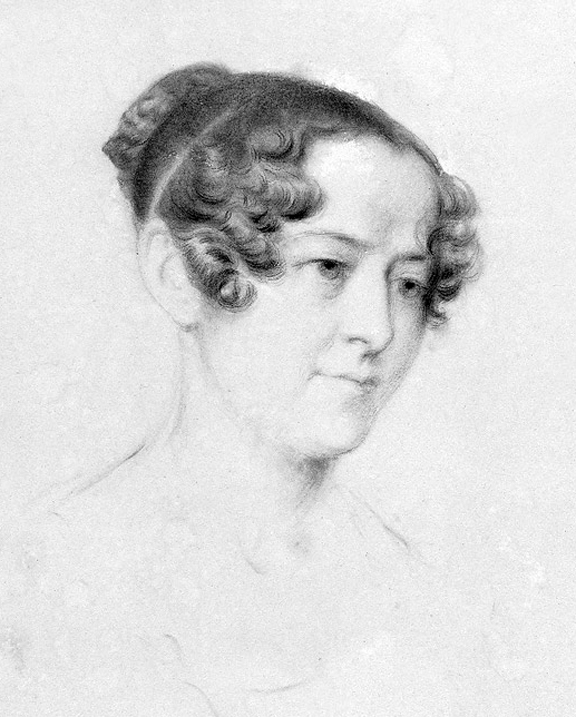
LADY FRANKLIN IN 3D

More than a year ago, I was complaining in this post called "The Elusive Lady", about the lack of portraits of Lady Jane which were available in the Internet. Only a couple of portraits of her are widely known. Apart of those two, in the book "Lady Franklin´s Ambition" I could recently see a tiny Jane together with her other three sibblings when they were mere children. And there is also, of course, the only known photograph of her discovered by Russell Potter and that drawing which I showed in the formerly mentioned blog post. 

Now, recently, after one of my Internet raids in search of Franklin related pictures and portraits, I am delighted to announce that I have found this rare and fascinating marble relief, which is attributed to Thomas Bock, the same artist who painted the Lady Jane´s portrait of 1838, during her stay in Van Diemen´s land.

Lady Jane Franklin


Apparently made by Thomas Bock

If you compare both, Thomas´s portrait and the bust, will agree with me that there is no doubt the woman represented is the same. Same hairstyle, nose, gesture of the mouth and slightly bulky eyes. She looks, however, thinner in the plaque and with a less prominent forehead:

Thomas Bock portrait of Lady Jane 1838

Thomas Bock was an English artist a year older than Jane Franklin. Bock was a promising engraver and miniature painter who was deported in 1823 to Autralia for administering drugs to a young woman. He was sentenced to stay fourteen years in Van Diemen´s Land, though after eight years of good behaviour, he became a free citizen. Among other things, his work includes Lady Jane´s commision of painting some aboriginals living in their natural state. Those pieces are of reknown value because are one of the few which show how those people actually were by that time without the influence of the european culture. Another well known painting is that which shows Martinha, the little aborigin girl adopted and subsequently abandoned by the Franklins during their stay. Hers, is a sad story which deserves a completely dedicated blog post.

Thomas Bock
That Lady Jane asked Thomas for being painted is an interesting event which forms part of the list of misteries which surround the elusive lady. Specially, if you take into account that she used to despise the company of convicts and exconvicts. Surely, it was the lack of skilled artist in the region and maybe also, Thomas´s impecable background in England before his crime, what called her attention and earned him her pardon.

But whatever were the actual reasons which ended in these two beatiful masterpieces, we should be thankful is thanks to this man that we, not only have a lively second portrait of a more mature Jane Franklin, which allow us to have an accurate idea of her determination by that time, but also a 3D bust which makes Jane Franklin a more real person, someone who looks about to move her head to look at you at your eyes to say some of her famous witty remarks with which she uses to end awkwardly bitter discussions.      

Post post: After sharing this un the facebook group "Remembering the Franklin expedition", I have learned there is another bust of Lady Franklin un the Royal Geographical society of London. This other was inspired in an earlier portrait. Unfortunately there are no pictures of It in  the Internet but I had the opportunity of seeing a picture and I have to say It was beautifully done.

martes, 23 de mayo de 2017

MUJERES EN LA EXPEDICIÓN DE FRANKLIN ¡¡LO SABÍA!!

Vivimos en un mundo extraño aunque no menos extraño que el mundo que nos ha precedido.

Hay en marcha una nueva investigación que intenta identificar a través del análisis del ADN obtenido en los huesos de las tripulaciones pertenecientes a la expedición de Franklin encontrados en la isla del rey Guillermo, quienes fueron realmente aquellos hombres. Quieren tratar de identificarlos con nombres y apellidos. Hay un buen número de descendientes de aquellos hombres con los cuales correlacionar los resultados.

De este análisis, han surgido ciertos resultados chocantes que están impactado de forma sensacionalista los titulares de algunas noticias. Aparentemente, existe la posibilidad de que participaran mujeres en aquella expedición cuando legalmente no deberían de haberlo hecho. Se ha descartado la posibilidad de que algunos de los huesos encontrados pudieran pertenecer a ninguna mujer Inuit que hubiera podido morir eventualmente en la zona, de manera que, de acuerdo a la edad de los huesos encontrados y a sus origines europeos, parece que éstos solo podrían haber pertenecido a algún participante de la expedición de Franklin.

Por lo que he leído, el análisis de estas pruebas no debe ser nunca considerado concluyente al cien por cien porque no es fácil averiguar la edad, o incluso el género, de ciertas muestras de ADN si éstas han sido expuestas a los elementos como ha sido el caso. Así que, a falta de una mejor aproximación, es aconsejable ser prudentes ante estas noticias.

Y ahora viene la parte que me gusta más. Hace tres años, en octubre de 2014, jugué precisamente con esta idea, de que podría ser que hubieran participado mujeres en la expedición de Franklin. En aquel entonces me pregunté a mi mismo: - ¿Porqué no?-  Ya habían estado penetrando en las filas de la Marina Real de forma inadvertida mucho tiempo antes de 1845 cuando la expedición partió. En aquella entrada de blog de hace dos años, y que podéis consultar más abajo, escribí exactamente lo siguiente:

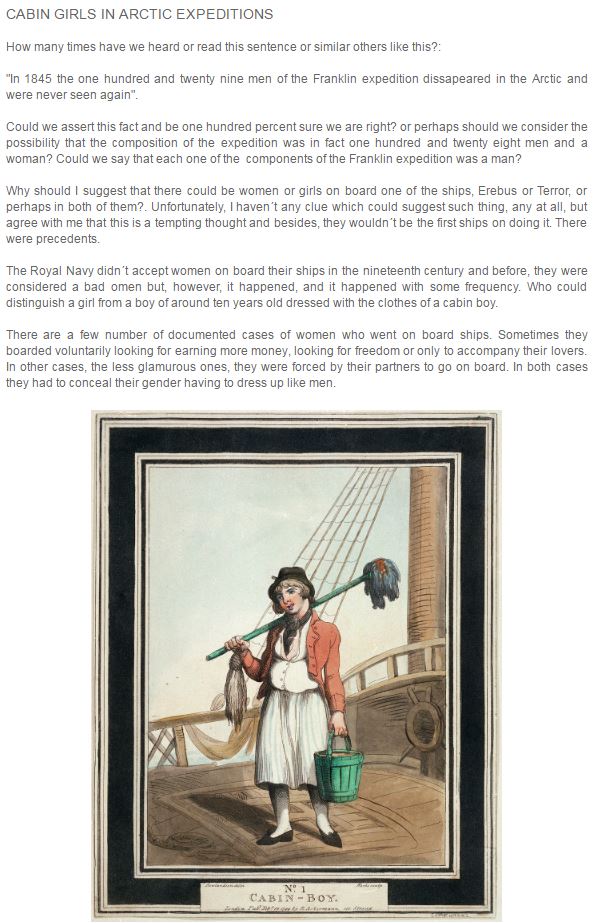
"¿Cuantas veces no habremos oído o leído esta frase, u otras parecidas como esta?:

- En 1845 los ciento veintinueve hombres de la expedición de Franklin desaparecieron en el ártico y jamás fueron vueltos a ver.-

¿Podemos asegurar este hecho? ¿Podemos estar cien por cien seguros de que estamos en lo cierto? ¿O quizás deberíamos considerar la posibilidad de que la composición real de la expedición fuera de hecho de ciento veintiocho hombres y una mujer? ¿Podemos afirmar que todos y cada uno de los componentes de la expedición de Franklin eran hombres?"

Podéis leer aquel premonitorio post aquí, (aunque en su momento lo escribí en Inglés y todavía tengo que traducirlo), donde recorría los casos mas conocidos de mujeres que se habían enrolado en las tripulaciones de los barcos de la Marina Británica.

"Chicas grumete" - Cabin girl post
http://kabloonas.blogspot.com.es/
Ahora, aunque me gustaría gritarle al mundo aquella frase de "¡Te lo dije!", en realidad estoy bastante seguro de que este no es mas que uno de esos juegos que la ciencia juega de vez en cuando con nosotros y que pronto se probará que ninguna mujer, o muchacha participó, nunca realmente en la expedición.

Estoy orgulloso de pensar que al fin y al cabo, yo mismo podría haber sido un "descubridor" de algo que estuviera relacionado con la expedición de Franklin. No es que hubiera sido en ese momento poseído por algún maligno espíritu que me mostrara la luz, o sido visitado por algún fantasma bien informado, como aquella experiencia vivida por la hermana de la difunta Weasy Coppin. Se trata más bien de que me gusta explorar cualquier posibilidad antes de descartar cualquier idea, no importa lo improbable que pueda parecer (reductio ad absurdum). Me siento a veces un poco como Henry Fonda en "Doce hombres justos, tratando de convencer a todos sus compañeros de jurado acerca de la inocencia del acusado. Si no puedes probar que es culpable, entonces éste debe ser considerado inocente (en realidad estaríamos hablando de presunción de inocencia, más que reducción al absurdo, pero vosotros me entendéis).  Si no podemos probar que todos los hombres de la expedición de Franklin eran hombres, entonces existe la posibilidad de que uno, o quizás más, pudieran ser mujeres.

En fin, que si finalmente se demuestra que una mujer participó en la expedición, continuaré soñando que alguien me premiará por esta deducción a la que llegué tres años atrás, espero que con algunas medallas, árticas si es posible, y que desde los salones del Almirantazgo Británico recibiré las correspondientes felicitaciones y hurras por mis servicios prestados en favor de la causa.

Kristina Gehrman, una fervorosa Franklinita, autora del único cómic publicado acerca de la fatídica expedición, sugirió que las posibilidades de que esto pudiese suceder eran exiguas. -¿Porque? - en su opinión, los exámenes físicos se suponía que tenían que ser concienzudos a la hora de seleccionar a las tripulaciones de aquellas expediciones Árticas, donde los participantes se suponía iban a estar aislados del mundo exterior durante años sin oportunidad de enviar a casa a los enfermos. Habría sido extraño que alguna mujer o muchacha hubiese escapado a ese examen. Es un planteamiento muy razonable a tener en cuenta. 

Yo por mi parte, no obstante, no estoy tan seguro, y aún albergo mis dudas al respecto. Muchos hombres fueron reclutados por recomendación de oficiales con los cuales habían navegado previamente. Quizás bajo la influencia de estos, aquellos hombres y quizás otros candidatos se saltaran los exámenes médicos. Por otro lado, no era infrecuente que los hombres se enrolasen padeciendo ya tuberculosis u otras enfermedades, que solían tratar de esconder para evitar ser rechazados. Si ellos eran capaces de eso, quizás, los eventuales aspirantes a tripulante del sexo femenino podrían haber ocultado también su género. Por cierto, y aunque no viene al caso, aquellos hombres que ocultaban sus enfermedades al embarcar, normalmente eran los primeros en morir en el transcurso de la primera invernada.

Continuemos entonces pensando que había mujeres entre las tripulaciones de los barcos Erebus y Terror y pongamos así algo de color y variedad a una historia que nunca cesa de sorprendernos con cada nuevo y sorprendente descubrimiento. Hace pocos días que se han reanudado las inmersiones en el naufragio del HMS Terror ¿Que será lo siguiente en dejarnos boquiabiertos? Me pregunto.