This site is a counter of curiosities and anecdotes related to the arctic polar expeditions happened between the S. XVI and the beginning of the S.XX
KABLOONAS
Burial of John Franklin. Author: me
KABLOONAS
Kabloonas is the way in which the Inuit who live in the north part of Canada call those who haven´t their same ascendency.
The first time i read this word was in the book "Fatal Passage" by Ken McGoogan, when, as the result of the conversations between John Rae and some inuit, and trying to find any evidence of the ill-fated Sir John Franklin Expedition, some of then mentioned that they watched how some kabloonas walked to die in the proximities of the river Great Fish.
I wish to publish this blog to order and share all those anecdotes that I´ve been finding in the arctic literature about arctic expeditions. My interest began more than 15 years ago reading a little book of my brother about north and south pole expeditions. I began reading almost all the bibliography about Antarctic expeditions and the superknown expeditions of Scott, Amundsen, Shackleton, etc. After I was captured by the Nansen, Nobile and Engineer Andree. But the most disturbing thing in that little book, full of pictures, was the two pages dedicated to the last Franklin expedition of the S.XIX, on that moment I thought that given the time on which this and others expeditions happened, few or any additional information could be obtained about it. I couldn´t imagine that after those two pages It would be a huge iceberg full of stories, unresolved misteries, anecdotes, etc. I believe that this iceberg, on the contrary than others, would continue growing instead melting.
There is an interesting aspect of the Polar expeditions data base on which I am working on which consists on identifying all the books published related with all of them.
The data base is not finished and may not be finished ever (I have 363 expeditions registered so far), but in the meantime and in honour of all of the members of the Remembering the Franklin expedition Facebook group, I have compiled all the books related specificaly with the Franklin expedition, fiction or not and also old and new. I don´t think any other expedition could reach the number of books of this list which overcome the 100´s, not even Scott vs Amundsen expeditions of 1911. So please, my beloved Franklinites, be prudent and think it twice before going for all of them!
I have to give a huge THANKS to the polar researcher Alison Fairchild who has kindly forwarded me an impressive list of polar books from which I could rescue many essential titles which I had omitted.
I have omitted those which tell the stories of the subsequent searching expeditions. Those are linked to their own ones, but I have included those books which give a broad picture about the whole history related with the discovery of the Northwest passage and also Sir John Franklin biographies.
There must be many more books out there, and in time the list will be more exhaustive than it is right now so ... don´t blame me please if any of your favourite ones is not among them, just warn me!!... and don´t doubt on telling me if there is any mistake or any duplicate, I am open to corrections and suggestions too.
Of course, you can check that the ESSENTIAL FRANKLIN BOOKSHELF, proposed by Russell Potter some years ago, is properly represented in the list below.
While looking for them I have found some whoich are completely new to me, and also others with titles so astonishing like this one:
"Euthanasia: a poem in four cantos of Spenserian metre on the discovery of the North-west Passage "
I hope you will enjoy the list and please, don´t forget to tell me which ones I have forgotten.
BOOK
TITLE
AUTHOR
YEAR
Neptune's
heroes; or, The sea-kings of England, from Sir John Howkins to Sir John
Franklin
Adams, W. H.
Davenport
1861
Crystal Vision
Alan
M Young
Life of Sir John Franklin and the North-west Passage (1891)
Albert
Hastings Markham
1891
The Ambitions of Jane Franklin: Victorian Lady Adventurer
Alison
Alexander
2016
Franklin: Tragic Hero of Polar Navigation
Andrew
D. Lambert
2010
The Gates of Hell: Sir John Franklin’s Tragic Quest for the
North-West Passage
Andrew
Lambert
The Man Who Ate His Boots: Sir John Franklin and the Tragic
History of the Northwest Passage
Anthony
Brandt
2011
Sir John Franklin: Expeditions to Destiny
Anthony
Dalton
2012
Sir John Franklin: The Man Who Ate Is Own Boots (Who Was.?)
Beardsley,
Martyn
2005
Deadly Winter: The Life of Sir John Franklin
Beardsley,
Martyn
2002
Sir John Franklin
Beesly,
A. H.
1881
Sir John Franklin
Brandes,
Karl
1854
The Ice Passage: A True Story of Ambition, Disaster, and
Endurance in the Arctic Wilderness
Brian
Payton
2010
Euthanasia: a poem in four cantos of Spenserian metre on the
discovery of the North-west Passage by Sir John Franklin
Brodie,
E. H. (Erasmus Henry)
1866
A sequel to the North-west passage and the plans for the search
for Sir John Franklin a review
Brown,
John
1860
The Emigrant's Farewell
Browne,
Liam
2007
Weird And Tragic Shores
C.C.
Loomis
2000
North-West by South. A novel
Cato,
Nancy
1980
Tracing the Connected Narrative: Arctic Exploration in British
Print Culture 1818-1860
Cavell,
Janice
Weird and Tragic shores
C.C.
Loomis
Captain John Franklin and Sir Ernest Shackleton: The History of
Britain's Most Famous Polar Explorers and Their Expeditions
Charles
River Editors
2018
Captain John Franklin's Lost Expedition: The History of the
British Explorer's Arctic Voyage in Search of the Northwest Passage
Charles
River Editors
2016
Mr Barrow of the Admiralty
Christopher
Lloyd
1970
Franklin's footsteps
Clements
Robert Markham
Epitome of spirit-intercourse a condensed view of spiritualism,
in its scriptural, historical, actual and scientific aspects;..
Manifestations in Nova Scotia; important communications from the spirits of
Sir John Franklin
Cridge,
Alfred.
1854
The Terror
Dan
Simmons
Unravelling the Franklin Mystery
Dave
Woodman
Strangers among us
Dave
Woodman
On the Proper Use of Stars
Dominique
Fortier
2011
Encounters on the
Passage: The Inuit Meet the Explorers
Dorothy
Eber
Lady Franklin of Russell Square
Erika
Behrisch Elce
Narrative of the Expedition in Search of Sir John Franklin and
His Party
F.
Leopold M'Clintock
1859
Les successeurs de Sir John Franklin scènes et tableaux des mers
arctiques
Feuilleret,
Henri,
1880
Schwatka's search; sledging in the Arctic in quest of the
The discovery of Sir John Franklin,
and other poems
Frederick
Schwtcka
Franklin, Happy Voyager. Being the life and death of Sir John
Franklin
G.
F. Lamb, John Franklin
1956
Franklin’s Lost Ship: the Historical Discovery of HMS Erebus
Geiger,
John and Mitchell, Alanna
Arctic Labyrinth
Glyn
Williams
Life with the Esquimaux: the narrative of Captain Charles
Francis Hall
Hall,
Charles Francis
The Navy the Company and Richard King
Hugh
N. Wallace
Sir John Franklin’s Erebus and Terror Expedition: Lost and Found
Hutchinson,
Gillian
Sir John Franklin the discovery of his fate - Forty years
silence now made public
J.
Henry Skewes
1889
Across the top of the world
James
Delgado
Across the top of the world
James
P. Delgado
As Affecting the Fate of My Absent Husband: Selected Letters of
Lady Franklin Concerning the Search for the Lost Franklin Expedition
Jane
Griffin
The Franklin COnspiracy White Horizon: The Arctic in the 19th Century British
Imagination
Jeffrey Blair Latt Jen
Hill
The Melancholy Fate of Sir John Franklin and His Party, as
Disclosed in Dr. Raes Report; Together with the Despatches and Letters of
Captain m'Clure, and Other Officers Employed in the Arctic Expeditions
John
Rae, Robert M'Clure
The melancholy fate of Sir John Franklin and his party, as
disclosed in Dr. Rae"s report; together with the despatches and letters
of Captain M'Clure, and other officers employed in the Arctic expeditions
John
Rae/Robert McLure
1854
Trapped
John
Roobol
2019
Franklin's Fate: an investigation into what happened to the lost
1845 expedition of Sir John Franklin
John
Roobol
Rear Admiral Sir John Franklin a narrative of the circumstances
and causes which led to the failure of the searching expeditions sent by
government and others for the rescue of Sir John Franklin
John
Ross
1855
North with Franklin
John
Wilson
Graves of ice the lost Franklin expedition Death in the Ice: The Shocking Story of Franklin's Final
Expedition
John Wilson Karen
Ryan
2018
Lament the night
Kassandra
Alvarado
White passage
Kassandra
Alvarado
Zombies: The Fall of london
Kassandra
Alvarado
Fatal Passage
Ken
McGoogan
2002
Dead Reckoning
Ken
McGoogan
Dead Reckoning
Ken
McGoogan
Lady Franklin’s Revenge
Ken
McGoogan
Overland to Starvation Cove With the Inuit in Search of Franklin
1878-1880
Klutschak,
Heinrich
Sir John Franklin: The Search for the Northwest Passage
Knudsen,
Anders
2007
Notice biographique sur l'amiral Sir John Franklin,
correspondant de la Société de géographie
La
Roquette, Jean Bernard Marie Alexandre Dezos de
The Gates of Hell: Sir John Franklin's Tragic Quest for the
North West Passage
Lambert,
Andrew
2009
Adventure to the polar sea,: The story of Sir John Franklin
Lambert,
Richard Stanton
Poems and Songs; with Lectures on the Genius and Works of Burns,
and the Rev, George Gilfillan and Letter on Sir John Franklin and the Arctic
Regions
LIVINGSTON,
PETER
1863
Life of Sir John Franklin and the North-West Passage
Markham,
Albert Hastings
1891
The Spectral Arctic: A History of Dreams and Ghosts in Polar
Exploration
McCorristine,
Shane
Erebus
Michael
Palin
Heroes of Discovery Livingstone, Park, Franklin, Cook, Magellan
Mossman,
Samuel
ARCTIC SOLITUDES
Mountevans,
Admiral Lord.
1953
Arctic heroes: facts and incidents of Arctic explorations from
the earliest voyages to the discovery of the fate of Sir John Franklin
Mudge,
Z[achariah]
1875
The Search for Franklin;
Neatby,
Leslie H.
The career, last voyage, and fate of Captain Sir John Franklin
Osborn,
Sherard, 1822-1875
1860
A POEM UPON THE LIFE AND CHARACTER OF SIR JOHN FRANKLIN
OWEN
A VIDAL
1860
Frozen in time
Owen
Beattie, John Geiger
1984
Frozen in Time: The Fate of the Franklin Expedition
Owen
Beattie, John Geiger
1984
Reflections on the mysterious fate of Sir John Franklin
Parsons,
James,
1857
Ice Ghosts: The Epic Hunt for the Lost Franklin Expedition
Paul
Watson
2018
Arctic Grail
Pierre
Berton
Sir John Franklin's Last Arctic Expedition (Search for Sir John
Franklin)
Richard
Cyriax
1939
Wanting
Richard
Flanagan
2016
Lost! The Franklin Expedition and the Fate of Captain F.R.M.
Crozier and the Crews of H.M.S. Erebus and Terror in 1848-1849
Richard
Galaburri
The Franklin Expedition from First to Last
Richard
King
The Fate of Franklin
Roderick
Owen
Hunters on the Track
Ross,
Gillies W
Finding Frankllin
Russell
Potter
2016
Arctic spectacles
Russell
Potter
The Search for the North-West Passage
Savours,
Anne
Ice Blink: The Tragic Fate of Sir John Franklin's Lost Polar
Expedition
Scott
Cookman
2000
The Beautiful Lie
Sheenagh
Pugh
2003
A narrative of Arctic discovery, from the earliest period to the
present time with the details of the measures adopted by Her Majesty's
government for the relief of the expedition under Sir John Franklin
Shillinglaw,
John J.
1850
Sir John Franklin and the Arctic regions: a narrative, showing
the progress of British enterprise for the discovery of the north-west
passage duing the nineteenth century
Simmonds,
P. L.
1853
Sir John Franklin
Sir
Henry Elliot
Sir John Franklin the true secret of the discovery of his fate :
a "revelation" : "a little child shall lead them"
Skewes,
J. Henry
1889
The town of Sir John Franklin : a history of Spilsby in
Lincolnshire, with notes on Eresby and other places connected therewith
Smith,
Harry Cotton
1892
Captain Francis Crozier: Last Man Standing?
Smith,
Michael
The Discovery Of Slowness
Sten
Nadolny
2019
The Relief of the Franklin Expedition: What Has Been Done and
What May Yet Be Done
Stuart,
John
Thompson, George Malcolm
The
North-West Passage
The Life of Sir John Franklin RN
Traill,
Henry Duff
The discovery of Sir John Franklin, and other poems
Turner,
J. A
1858
Relics of the Franklin Expedition
Walpole,
Garth and Potter, Russell
Ice Ghosts: The Epic Hunt for the Lost Franklin Expedition
Watson,
Paul
Franklin and McClintock: Poems
WEST,
David S.
1977
The frozen Deep
Wilkie
Collins
James Fitzjames: The Mistery man of the Franklin expedition
William
Battersby
The Franklin Expedition: Or Considerations on Measures for the
Discovery and Relief of Our Absent Adventurers in the Arctic Regions
William
Scoresby
1850
The Man Who Ate His Boots: Remarkable Story of Sir John
Franklin,1786-1847
Wilson,
Catherine M.
1994
Boundless: Adventures in the Northwest Passage
Winter,
Kathleen
Thirty Years in the Arctic Regions: The Narrative of a Polar
Explorer (Paperback)
Great Explorers: Marco Polo, Ferdinand Magellan, Mungo Park, Sir
John Franklin, David Livingstone, Christopher Columbus, etc.
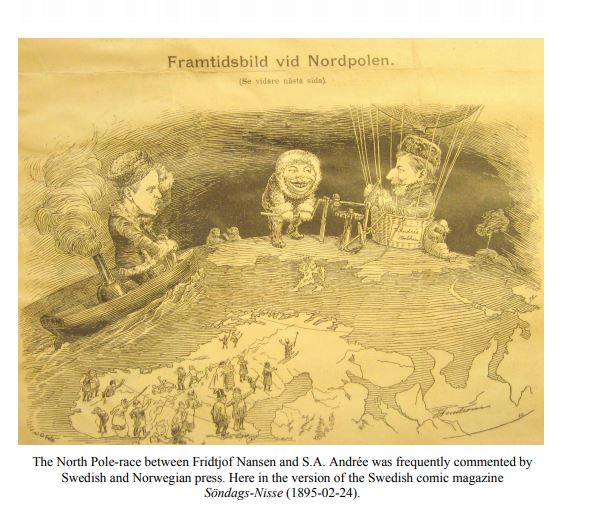
Ayer preguntaba Miguel Angel Quereda, un entusiasta y amante de la historia de las expediciones polares como yo, acerca del nombre del globo con el que Salomon Andree trató de alcanzar el polo Norte durante sus expediciones de 1896 y 1897 fué bautizado. Al parecer, en algún lugar se decía que el aerostato podía haberse llamado como el barco de Nansen, el Fram.
En realidad el verdadero nombre con el que se bautizó a la aeronave era "El Águila", "Ornen" en Sueco. No tengo claro el origen de este nombre, puede que fuera porque el aguila real habita la Laponia Sueca, o porque fue parte de su escudo real en algún momento de la historia, pero aunque su nombre no coincidía con el de su homólogo marítimo, el Fram hace su aparición en escena en la historia de la expedición de Andrée como uno de esas coincidencias que parecen solo ocurrir en las películas de aventuras.
Gracias a Miguel y también porque precisamente ahora, Borge Ousland y Mike Horn se encuentran embarcados en el Pangea navegando hacia el norte pasado el estrecho de Bering con intención de protagonizar una hazaña similar a la de Nansen,, se me ha ocurrido hacer una breve reflexión acerca de este hecho. Borge y Mike se encuentran en estos mismos momentos tratando de alcanzar la máxima latitud norte posible antes de desembarcar para comenzar su temerario intento de cruzar el polo Norte al final del verano ártico. El Pangea tendrá que volver posteriormente a recogerlos precisamente en el archipiélago de Svalbard (o Spitzbergen, como se denominaba antaño), donde Salomon Andree se encontraba 123 años antes preparando su vuelo, después de una durísima travesía que se supone durará más de dos meses.
José Mijares, uno de nuestros paisanos expedicionarios afincado en las vecindades del Cabo Norte, nos está manteniendo puntualmente informados a todos los enamorados de las regiones en el grupo de Facebook "Del Artíco al Antártico" acerca de sus avances. A algunos no nos cabe el corazón ya en el pecho esperando los siguientes acontecimientos...
En el libro "El globo de Andrée", he encontrado la descripción de aquel histórico encuentro al que me refería anteriormente. A mediados de Agosto de 1896, mientras el equipo de tierra de la expedición de Salomon estaba inflando el globo en el hangar que habían construido al norte de Svalbard, apareció en el horizonte un buque de tres mástiles que procedía del norte. Nada sorprendente en principio sino fuera porque al norte de Svalbard, a poca distancia de sus costas, comienza la banquisa helada, el casquete polar. Un mar helado infranqueable en aquel entonces que cubre el extremo septentrional del planeta y que rodea al Polo norte, lo defiende de su asalto por los humanos como una inexpugnable fortaleza y que por aquel entonces todavía no había sido vencida.
Allí, virtualmente a las puertas del fin del mundo, se generó inmediatamente una gran excitación que se extendió como pólvora ardiendo tanto en el hangar en tierra donde se alojaba el aerostato como por el Virgo, el barco de apoyo que acompañaba y aprovisionaba a la expedición.
¿Que pintaba en aquellas latitudes un barco cuando esa región solo era visitada por balleneros y turistas? Aquel misterioso navío se detuvo e izó la bandera noruega en el palo mayor. Un grito se alzó en el aire procedente de los corazones de todos aquellos que lo presenciaron. Los que habían visto alguna vez alguna foto suya lo reconocieron al instante por su peculiar forma, era el Fram.
De repente, un grito rompió la quietud de aquella plácida atmósfera ártica.
"¡Es Nansen! ¡Nansen ha regresado del Polo Norte!"
Enseguida, Andree y sus compañeros exploradores se acercaron al barco y vitorearon a los marineros del Fram cuando se encontraban a tiro de piedra de ellos, pero el rostro de estos, sin embargo, estaba dominado por la pena. Nansen no estaba con ellos. Solo hacía un día que el Fram había sido liberado del hielo unas millas al norte, a una latitud de 81º. El mar helado había transportado miles de kilómetros sobre su superficie a aquellos hombres a bordo de su formidable nave durante tres años y dos meses. Hasta entonces no se había tenido noticias de ellas, algunos incluso los daban ya por perdidos.
El capitán Sverdrup que comandaba el Fram y la tripulación se encontraba a salvo, la banquisa les había perdonado la vida, pero Nansen no se encontraba a bordo, había abandonado el barco el 14 de marzo del año anterior, 1895, a una latitud de 84 º junto a su compañero el joven teniente Johansen con 28 perros, trineos y provisiones para cuatro meses para intentar alcanzar el Polo Norte andando.
El Fram en Tromso
Después de su visita, Andrée invitó al capitán y a parte de la tripulación del Fram a visitar sus instalaciones en tierra. Es fácil imaginar su cara de asombro cuando vieron el espectacular despliegue que Salomon Andree tenía montado en aquel remoto lugar. Como algún testigo diría en uno de los libros acerca de la expedición:
"Es un placer ver a estos hombres tan contentos de encontrarse entre hermanos de armas (Brothers in arms) y compañeros de peligro." .
Después vinieron los brindis y más vítores. Aquellos bravos hombres habían llevado la bandera noruega a los 86 º de latitud batiendo todos los records existentes y, aunque todavía no se tenían noticias de Nansen, era posible que éste y Johansen la pudieran haber plantado en el mismísimo Polo Norte deteniendo en seco la loca carrera en la que tantas naciones se habían embarcado. Andrée, el competidor sueco que había planeado aquel loco intento de alcanzar el Polo en globo, le dio al capitán Sverdrup una misteriosa carta con la inscripción "El Polo Norte" para Nansen, cuyo contenido supongo que consistía en una cortés felicitación en caso de que el explorador hubiera logrado su objetivo.
Era el verano del año 1896 y Andrée se tuvo que retirar porque no se levantaron los vientos del sur propicios que tendrían que haberle llevado al Polo Norte. Resignado, tuvo que desinflar la enorme esfera y emprender el regreso para volver a intentarlo el verano siguiente. Nansen, entretanto, había regresado de su odisea polar también sano y salvo, pero no había alcanzado el Polo. Apareció junto a su compañero poco tiempo después que el Fram protagonizando otro sorprendente e inesperado en encuentro con el explorador Británico Jackson en la Tierra de Francisco José. Por lo tanto Andrée tenía todavía la oportunidad de ser el primero en lograrlo, todo el mundo estaba pendiente de él. Nansen y Andrée tuvieron la oportunidad de encontrarse en Tromso como si se estuvieran pasando el relevo para el siguiente intento.
Aquel segundo verano (año 1897), desafortunadamente para Andrée, si que soplaron los vientos que tanto necesitaba y que al parecer eran bastante raros en aquella región. El Ornen alzó el vuelo orgulloso entre gritos de alegría y una inmensa expectación ¿Sería Andrée, cabalgando en su águila, el primero en alcanzar el polo Norte?,
El Ornen se elevó, las cuerdas que le unían a tierra se cortaron, como se corta un cordón umbilical entre un bebé y su madre, y desapareció en el frío aire de las islas Spitzbergen en pos de su ansiado Grial. No se tendrían noticias de su paradero hasta 33 años después cuando los cuerpos de los tres exploradores aparecieron en la isla de Kvitoya, o isla blanca, que pasa casi desapercibida en aquel desierto helado y que se encuentra a unos 400 km al este de donde partió su globo.
Junto a sus cuerpos, apareció un conjunto de fotografías y sus diarios, documentos congelados que esperaron pacientemente durante todo ese tiempo para poder aportar algo de información acerca de lo sucedido. Sin embargo, los últimos días de los tres exploradores quedan encerrados en un misterio que a día de hoy no es otra cosa que materia de especulación.
Volviendo a nuestra era, no cabe esperar que Borge y Mike protagonicen un fortuito encuentro similar al de Nansen y Jackson, entendemos que los medios de hoy en día, teléfono satélite, GPSs, etc, harán que el encuentro entre el Pangea, o quien sea el que les recoja del hielo o el mar en las proximidades de la Tierra de Francisco José sea programado. Pero, como José Mijares nos ha advertido, la época del año en la que se están aventurando, la prácticamente nula posibilidad de rescate y el incierto espesor del hielo por el que tendrán que transitar, hace que para aquellos que estamos siguiendo el devenir de esta expedición, no nos llegue el cuello a la camisa a causa de la preocupación acerca de su seguridad de una forma muy similar a como el mundo vivió hace más de un siglo el transcurso de las expediciones de Nansen y Andrée.
Mientras escribo estas líneas los buceadores de Parks Canada y la población local Inuit de la isla del rey Guillermo, se encuentran en el mismísimo corazón del Ártico Canadiense a bordo del buque de investigación "David Thompson" asediando los restos del HMS Terror. El Terror era el buque consorte y gemelo del HMS Erebus que Sir John Franklin capitaneó en su intento por lograr descubrir el tan ansiado y elusivo paso del Noroeste.
Como sin duda muchos sabéis a estas alturas, los dos barcos desaparecieron sin dejar rastro en el año 1845 y, a pesar de que numerosos restos dejados por las tripulaciones en su intento de escapar de las garras de aquellas inhóspitas tierras han sido encontrados desde entonces, no ha sido hasta tiempos muy recientes que ambos buques naufragados han sido hallados.
Hace muy pocos días, Parks Canada publicaba en su web un vídeo que ya ha dado la vuelta al mundo. Se trata de siete excepcionales minutos que muestran el increíble estado de conservación en el que se encuentra el HMS Terror. Por desgracia el HMS Erebus se halla en un estado mucho más deplorable aunque también está siendo investigado.
Esta es la primera vez que la organización gubernamental Canadiense publica un vídeo tan bien estructurado con imágenes espectaculares del interior del buque. El hecho de que el vídeo esté atrayendo la atención de todo el mundo no se debe solo al hecho de que pertenezca a la expedición de Franklin, que ya de por sí es un hecho histórico, sino a que es la primera vez que se encuentra un barco de esta época en tal fantástico estado de conservación.
La comunidad "Franklinita" de individuos enganchados a esta historia, como algunos nos llaman o nos llamamos a nosotros mismos, ha analizado cada fotograma de este corto vídeo tratando de identificar todos y cada uno de los objetos que aparecen en ellos. A veces el resultado de estos análisis ha sido mera especulación que seguramente se aleje infinito de la realidad, pero en otros casos se ha podido determinar que objetos aparecen en escena.
Los investigadores han utilizado Drones submarinos que han recorrido la cubierta y los laterales del barco, se han introducido también por las compuertas que se encuentran abiertas y por la ventana rota de la cabina del capitán, Francis Moira Crozier.
Las imágenes nos transportan en el tiempo primero mostrándonos el excepcionalmente bien conservado bauprés, el doble timón y un bote que en su momento estuvo colgado de sus correspondientes anclajes y que ahora yace junto al casco del Terror. La narradora del video lo describe de esta manera:
"Los restos del HMS Terror yacen majestuosamente al fondo del mar. La proa del naufragio es particularmente espectacular, cortando las aguas túrbidas Estas imagenes sirven de confirmación de que el Terror se ha conservado muy bien por las frias aguas de la bahía del Terror y por capas de sedimento protector. El timón permanece erguido después de haber soportado el paso del tiempo. Un pequeño bote que originalmente había colgado de los pescantes descansa ahora al lado del barco. "
Posteriormente, el dron, se introduce por debajo de la cubierta principal por la parte de proa para investigar las zonas comunes donde los marineros comían, se reunían y dormían y se dirige más tarde hacia la popa paseándose por el pasillo que da paso a los camarotes de los oficiales, en uno de los cuales se adentra para explorar su interior. Como la narradora dice:
"En dirección a la popa un largo corredor se dirige a la oscuridad revelado las puertas abiertas de los camarotes individuales de los oficiales"
"Cada cabina es un mundo personal ahora congelado en el tiempo."
Camastros, platos de porcelana perfectamente colocados en sus estanterías, cajones, platos de madera, un trípode seguramente parte de algún instrumento científico, dos escopetas colgadas de la pared, botellas de cristal, cajas para rifles, una taza de cobre seguramente para medir la cantidad de ron a verter a la hora de preparar el Grog, etc. asombran al espectador porque, como muchos han comentado, parece imposible que tales objetos puedan encontrarse plácidamente ubicados en sus correspondientes emplazamientos como si nada hubiera pasado.
"Dos armas de fuego cuelgan todavía de la pared, prisioneras del óxido formado durante décadas"
El vídeo termina con una corta visita a la cabina del capitán, donde una mesa y una silla parcialmente enterrada en más de medio metro de sedimentos, parece invitarnos a sentarnos a consultar un mapa que posiblemente se encuentre sobre ella. El dormitorio del capitán, anejo a la cabina principal, sin embargo, se encuentra misteriosamente cerrado. ¿Que albergará en su interior?
Los testimonios Inuit hablan de que alguno de los barcos albergaba el cadáver de un hombre, tan grande que varios nativos no pudieron levantarlo, un hombre con dientes largos, extraordinariamente largos. Hay testimonios que lo sitúan en el suelo y otros que lo emplazan en uno de los camastros. También es posible que se hable de dos cadáveres distintos en distintos barcos o encontrados en diferentes ocasiones. ¿Es posible que ese cuerpo del que hablaban aquellos que visitaron los buques antes de que se hundieran esté alojado dentro de este habitáculo?
Especulaciones de todo tipo circulan entre expertos y amateurs, algunas sorprendentes y más generosas imaginan a un capitán encerrado voluntariamente en su cabina, donde se cree que pudo perecer derrotado por la falta de alimentos, exposición al frío y al escorbuto. Hay quien como yo, opina que pudo ser encerrado forzosamente durante el estallido de un motín y enviado a pique con el barco que capitaneaba. El misterio está servido y las pruebas dan lugar a todo tipo de interpretaciones y conjeturas creativas. Con el tiempo, el dormitorio se abrirá y sabremos que esconde su interior.
Todavía no se tiene una idea clara de si el barco llegó sin tripulación hasta donde ha sido encontrado, la bahía del Terror, arrastrado por el hielo a la deriva, por las corrientes marinas o si por el contrario fue reocupado después de su inicial abandono para ser dirigido al lugar donde ha sido encontrado hundido. El estado del interior y algunos otros indicios apuntan a que fue desalojado en orden y que las compuertas fueron convenientemente cerradas tal y como se hacía en esas situaciones. Existen precedentes de abandono de barcos en similares circunstancias y el protocolo parece haberse seguido también en esta situación. Sin embargo, el barco no parece haber estado anclado donde se ha encontrado, no hay anclas ni de fondo ni para el hielo dispuestas para fondear e invernar. La hélice con la que dotaron al barco (*) está en posición, lo cual parece también incongruente con el hecho de que el barco se encontrara atrapado por el hielo cuando se hundió, ya que la hélice disponía de un sistema que permitía izarla en caso de posibles daños por atrapamiento por hielo. ¿Llevaron algunos marineros supervivientes el barco a la bahía que lleva su nombre (**)?. Esta es una incógnita que seguramente el trabajo arqueológico que se está llevando a cabo pueda resolverse durante esta misma temporada.
* Los barcos fueron dotados de máquinas locomotoras de vapor y de un sistema de propulsión a hélice, algo que nunca se había probado en aguas polares. El nuevo sistema, incluía un sistema de izado de la hélice que permitía alzarla e impedir que los hielos que circundaran el barco pudieran dañarla. **Es curioso que el nombre de la bahía fue puesto muchos años antes de que el barco fuera descubierto.
La rotura del cristal de la cabina, aunque se pensó en un primer momento que perjudicaría el estado del interior de la misma, ha resultado sin embargo ser una bendición que ha permitido que los sedimentos se hayan depositado creando una atmósfera anaerobia que es posible, esté protegiendo los documentos que puedan encontrarse enterrados en ella.
La narradora, nos deja atónitos al comentar lo siguiente:
"Dentro de la cabina, hay una mesa de trabajo que domina el centro de la habitación con cajones sellados que muy probablemente contienen información esencial acerca de la expedición de Franklin."
"Estas imágenes confirman la posibilidad de que encontrar documentos escritos no es solamente real sino que además es posible que se puedan encontrar una gran cantidad de estos."
En fin, os podéis imaginar que desde que se ha publicado este vídeo el corazón no me cabe en el pecho, pero es necesario tener paciencia. Las ventanas de tiempo durante las cuales se puede realizar una exploración efectiva de los naufragios son extremadamente cortas, con suerte se dispone de tres semanas o un mes para realizar los trabajos necesarios. El trabajo que acaba de comenzar durará años, pero con total seguridad en el transcurso de todos ellos, Parks Canada nos sorprenderá con impresionantes descubrimientos que nos dejarán sin respiración.
When Sir John Franklin vanished during more than two years trying to find a northwest passage without giving the smallest signal of life to the outer world, the Admiralty lazily began to organize searching expeditions for him. The most varied number of ideas of all sorts produced by all kind of people, appeared in the Admiralty mail box describing the most surprising and imaginative means to locate the explorer and his lost men.
These facts brings to my mind the relatively recent events happened in Thailandia, when that group of children got trapped in the interior of a very complicated cave called Tham Luang. A lot of ideas about how to perform the complex rescue were put on the advisory board´s table, some of them impossible to carry out, but others like Elon Musk´s capsule or minisub were concepts which could seem shocking at first sight, but which for some sounded plausible after second thoughts.
Some of the suggestions to locate Franklin made during the years that the rescue missions were being organized were mere bizarre digressions made by private individuals. The result surely of the combination of their boundless imagination, nightmares or just bad hang outs which were quickly scribbled in papers and sent to the Navy thinking heads. But other ideas were produced by prominent people and deserved the attention of those who were defining the rescue program. They were actual inventors, masters on the areas they were working. That was the case of Lieutenant George B. Gale and John Hampton, renowned ballonists who by that time had performed some relevant ascentions which had gathered international interest.
In autumn of 1849, Lieutenant George B. Gale proposed Lady Jane to use a balloon which should ascent from one of the searching ships and reach a height of two miles to be able to scan a significant part of the horizon in search of any clue which could led them to the whereabouts of the lost expedition. Though apparently quite a logical proposal for a modern individual, people of that age didn´t receive it with the due enthusiasm and the press, prone to mock any extravance, particularly those related with polar exploration, loomed over Gale ravenously. The Era called him "Columbus of the Skies" in october of 1849, though they used that term for other flying pioners of the time in subsequent publications. The Punch punched a bit stronger with this short and, as usual, acid post:
George Burcher Gale, formerly an actor, wasn´t however as stupid as may be depicted by the Polar detractors journalists of Punch. In fact he was a successful balloonist which career as an aeronaut had started at a proper time, 1848, to be of some service for the Franklin expedition rescuers.
By 1850 he had performed at least 114 ascentions. The summer of that year, he kept on describing his plans for rescuing Franklin in the lectures he gave and complaining about the behaviour of the Admiralty which, according to him, had adopted his methods and was performing some tests but with inadequate material and by "ignorants of principles of aeronatics".He also described his smallest versions, the messenger ballons, which were used during the searching squadrons of 1850 and 1852.
It was during an exhibition in september of 1850 in the hippodrome of Vincennes at Bordeaux where poor Gale lost prematurely his life after suffering a mortal accident. By the effect of an unlucky misunderstanding between his team and himself, after landing safely, while emptying the balloon, his men released the ropes which held the aircraft which carried away an horrified Gale hanging somehow from the basket, which had previously overturned. He was taken to the sky for the partially emptied sphere out of the sight of the astounded audience. His body was found the following day some miles away from the landing point in the middle of a close forest. This bizarre end contrasts strongly and paradoxically with the assertions made by him during the Leicester square´s lecture described in the article posted above on which he claimed that:
"He says that nearly all the serious or fatal accidents in ballooning have happened with inexperienced and incompetent aeronauts, who were unacquainted with the principles and details of the science, and makes the rather bold assertion that there is no much safety in, the car of a well managed balloon as in a railway carriage, the cabin of a steamer, or the inside of a stage-coach" this text
The fact was that the idea had somehow made an impression in the upper circles of those organizations which were collaborating in organizing the searching. Charles Richard Weld, the assistant secretary of the Royal Society proposed precisely not only using unmanned balloons to release papers with messages addressed to the lost men but also using manned balloons to explore the surroundings of the searching ships as far as possible. John Hampton, another aeronaut, wasn´t a lunatic neither. He was another visonary man who followed the dangerous career of parachutist initiated by André-Jacques Garnerin in 1797. Garnerin was the first on jumping with a primitive parachute from a balloon and be lucky enough of landing roughly but safely in Parc Monceu of Paris after a heart-stopping descent. Hampton was an extraordinary bold man who was a reference in the small world of balloonists of the time and who had performed a number of previous flights. To illustrate his audacity, we have the Canterbury´s flight of 1839 which ended with him perched in the hoop of the balloon whose car he had to cut away to reduce weight. If you make zoom in the picture below you could see a tiny Hampton grabbing the rigging of the inflated sphere:
1839 ascention at Canterbury
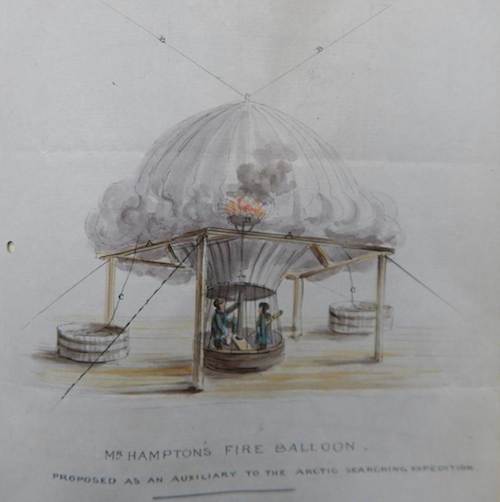
He was working by that time in the combination of two different techniques, hot air balloons which have been forgotten since the arrival of hydrogen filled balloons and parachuting. A hot air balloon could be easier to use in the arctic regions because it made unnecesary to produce the huge amount of hydrogen needed to lift the weight of a man.
John Hampton
In april of 1848, precisely when the remaining crews from Erebus and Terror were abandoning their ships, he was dmonstrating the world again his bravery in Rotundo Gardens, Dublin jumping from a ballon at a height of 3.000 m (10.000 ft). That wasn´t his first jump, ten years before, in 1838, he had performed a succesful parachute jump in Cheltenham, England, becoming the first englishman parachutist. Here there is an interesting article by John Lucas which describes well his historic jumps and the devices he used in his jumps.
In june of 1850 Hampton proposed the Admiralty to use his improved hot air balloons, called by him "Artic surveying balloons". He apparently performed that same year another demonstration in Rotunda Gardens, Dublin, where it would be tested the messenger balloons and the manned one carrying not one but two passengers on board the basket. The balloon dessigned by Hampton had a diameter of almost 14 m and 21 m of height.
For some reason, only his proposal related with messenger balloons, also made by Gale as was described earlier, was adopted by the Admiralty. Likely, the manned option was rejected due to the inmense size of the necessary fabric for such flights or maybe, someone thought that a hot air ballon could not carry out its duty properly in the extremely cold air of the Arctic regions. Maybe someone in the Admiralty had foreseen this difficulties and was reluctant to sacrifice the so much need room for provisions on behalf of a very likely fiasco which could have been difficult to explain. At the end of the day, we all know the difficulties Scott had to fly his manned balloon in the Antarctic (in "Exploring Arctic Frontiers" is described on which other polar expeditions were manned balloons used before Scott) maybe not carrying them wasn´t a bad decission after all.
But what if they had worked well? Could the use of those innovative means of transport have been of some usefulness for the searching parties? I guess so and I bet for it. In the book "Hunters of the track" there is a brief discussion about the subject. My opinion is that it could have been useful not only for locating Franklin ships but also for the geographical work, don´t forget that was the underlying target of many of those searching operations. I have no doubt that if available then, John Ross would have found Bellot strait during his expedition of 1829-33 had he used Hampton´s "Artic surveying balloons". Or who knows if the very same Franklin would have recognised from the air that King William Island was in fact an island and not a peninsula as it was widely believed in 1845, saving therefore his life and the life of his men. That´s a thing we will never know but it is stimulating and tantalizing to play with the idea of James Fitzjames and Francis Crozier on board a fragile basket, flying over Cape Felix at several hundreds of meters from the ground, with an impressive view at the bottom of their two tiny ships beset and frozen, surrounded by tens of men anxiously looking up at them spreaded like black dots placed in the ice while the officers were spotting through their chilled spyglasses a completely free of ice Rae Strait. That would have changed the dramatic outcome of all this mesmerizing tragedy, don´t you think?
Long time ago I started another of my mammoth projects, the ARTIC GRAVEYARD, a map which shows (or will show when finished) all the men and women killed or lost in "action" while participating in polar expeditions. It also includes the graves of those who were lucky to come back home, or at least made it to die between the two polar circles at home or in the course of any other adventure.
I think this was the first "Geographical" project on which I began to work but for some reason it has been the last of all on seeing the light. Though it is far from being complete I have decided to publish it now and not waiting a minute more to finish it, a thing it would likely never happen.
Jonathan Dore, the polar specialist, did some months ago a huge contribution to the project forwarding me a map with lots of these "polar casualties". His work was mainly focused in the earlier centuries of polar exploration, precisely the most difficult area of the history to scan. You can imagine my face when he, a man I have never met in person, did that. What Jonathan, and other polar friends I have made in the course of the years I have been working on this blog, did are the kind of things which makes me keep on working amateurishly hard for all those who have interest in this things.
So, here it is the result of the combination of our join work. I hope you will like it and will amaze, the same I did before the impressive sight of all those places spreaded all over the world where so many died. It is also horrific thinking that a big number of those lost people were, and will, never found.
I have deduced from my other previous works that a cooperative work is essential to give shape to this kind of projects. I have counted in the former ones with the disinterested and invaluale help of many polar enthusiasts which have assisted me to make more perfect and decent maps like the map which shows where the relics of the Franklin expedition are, the map which shows many of the polar memorials and other polar related elements which are spreaded all over the world and maybe the most ambitious of all, one which is aiming to show all the routes followed by the polar explorations of all times. You can visit them in the maps section of this blog and colaborate if you want. I can´t offer nothing in compensation but a "Thank you" in the box which bears the description of the pinned item.
Now it has come the time to honour those men and woman who lost their lives trying to reach the Arctic and Antarctic chimeras wherever they were or were located. Whenever it has been possible names and dates of those who died have been added to the description of the pins or to the labels, which only in some cases are accurately located. Many more death places will come in the future to fill some blanks but many others will likely remain unknown forever.
Now, let´s take a look to this particular worldwide Polar Hall of fame and amaze ourselves before the impressive dimensions of the tragedy which by definition is linked to the term "Polar exploration".
A good number of times I have heard or read that more people died trying to find Franklin and his men than in the expedition itself, an affirmation which I have always thought was an exaggerated one.
We have talked about that previosuly in this blog, but though I don´t have yet the precise figures of the men who died in the pack of expeditions which departed trying to locate the missing Franklin expedition, it is hard to imagine that the number of casualties during all of them could reach 129, which is a very big number.
Time ago, while reading the narratives of those searching expeditions, I was curious about those other graves which splashed the arctic scenario like those so famous of Beechey island. I started to compile the names of all those men, noting the date they died, the causes of their deaths, ranks, burial places, etc.
I wrote about Port Leopold, Dealy island, North Star Bay, Griffith island and other places trying to raise certain awareness about the men who lie there, thinking than in those remote places there were incorrupted bodies like the three from Beechey island. Graves, sometimes unlocated but which a day long time ago, beared forgotten names. Those names are not written in tombstones in the heads of their graves, sometimes because, as I said above, the burial sites are not located and in the rest of the cases because nobody has replaced the original and lost headstones for new ones, like happened with those of the Franklin men.
I am publishing the list here now, and will update these days because my intention is to finish it and convert it into an exhaustive one. My original intention was to publish an article about this subject but I have realised that surely this thing is never going to happen in the short term.
Meanwhile, here is the list of those forgotten men who, in some cases, are sleeping, likely, uncorrepted in their lost graves there, in the north, very far from their houses and descendants.
It is not clear however where I have to look to fulfill the incomplete lost. There is no uniform agreement regarding the expeditions which should be considered as "Searching expeditions" as such. There is an interesting article by W.Gillies Ross called "The Type and Number of Expeditions in the Franklin search 1847-1859" which adress the topic. I will look into the pages of the narratives of the following list wich is part of a data base on which I am working which gathers all the polar expeditions of all times. For now, the death toll reaches the not at all insignificant number of 39.
This project (the list of lost men who died while looking for Franklin) evolved in a more massive and ambitious one which I call the Artcic Graveyard on which I am trying to locate all the places where arctic and antarctic explorers died. To this task I have counted with the unexpected help of the polar expert Jonathan Dore who added to my already long list, a huge number of men. I hope to be able to publish this map here in my blog soon.