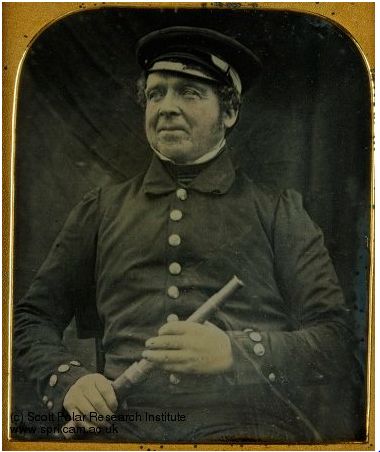
"Willing to go" - These three words written the 11th july of 1845 show the spirit of a man, not a very well known man indeed. These three words show actually the spirits of the whole companionship who went together with Sir John Franklin to the Arctic.
Time ago I published a short
post here where I tried to draw him. On that time I couldn´t find any specific information about this man. I didn´t have even read the description of him made by james Fitzjames in one of his letters where he was described as a rough but affable man.
 |
James Reid Ice Master of HMS Erebus - Franklin expedition of 1845
From: www.luminous-lint.com
http://www.luminous-lint.com/app/image/9735538391961973629611/ |
It has been now that I have discovered this
short article in
The Register (or also called the South Australian Register) where I have found much more valuable information on which this man is well described and what is even more curious, I have discovered on it that he had in his hands the opportunity to avoid the disaster.
James Reid was a man who kept an intense correpondence with his wife. On one of his letters written to her the spring of the fateful year of 1845 (22th of march 1845) he told his wife that he had been asked by a shipowner to go on board the ship Neptune to sail to Quebec in April. He told her spouse that he refused that offer because he was at this point committed with Sir John to depart in the Franklin expedition to the North.
His fate was then sealed but his words show an involved man with high expectancies on this particular journey:
"It may be two years, it may be three or four, but I am quite willing to go"
This phrase not only is a demonstration of his mood but it is also the key which teach us that this man, at least on these previous stages of the preparation of the expedition, was more than concious that the expedition could last even four years. A point which has been sometimes questioned, however after, in a letter sent from Whalefish Islands, he mentions that they were carrying only provisions for three years. He continuous:
"Sir John told me that if I went the voyage with him and landed safely in England again I would be looked after all my life"
In this case, another fact is revealed, the trust which the men of the Franklin expedition had laid on their Commander. A thing which one could easily believe if one analyses the treatment received after previous expeditions for other of his previous companions.
Reading forward he wrote this dark forecast:
"Mr Enderby has been a good friend to me. He will look after you if I should never return"
And follows:
"No doubt there will be a great talk about me going this voyage. . It will show that I am not frightened for my life like some men. It is for you and the family. Why should a man stop at home?"
Saying that "he wouldn´t show he wasn´t frightened" implies to me that he was scared to death about this adventure. Precisely because of his knowledge of the arctic regions and the dangers which the ice involves James Reid surely was one of the more aware about the hell through which they were going to sail .
Another curious thing mentioned in the article is that the officers "had to" buy their own silver spoons and forks. Reid complains about those expenses. Were they obliged to buy their own cutlery?, Was that a formal prescription for the officers?.
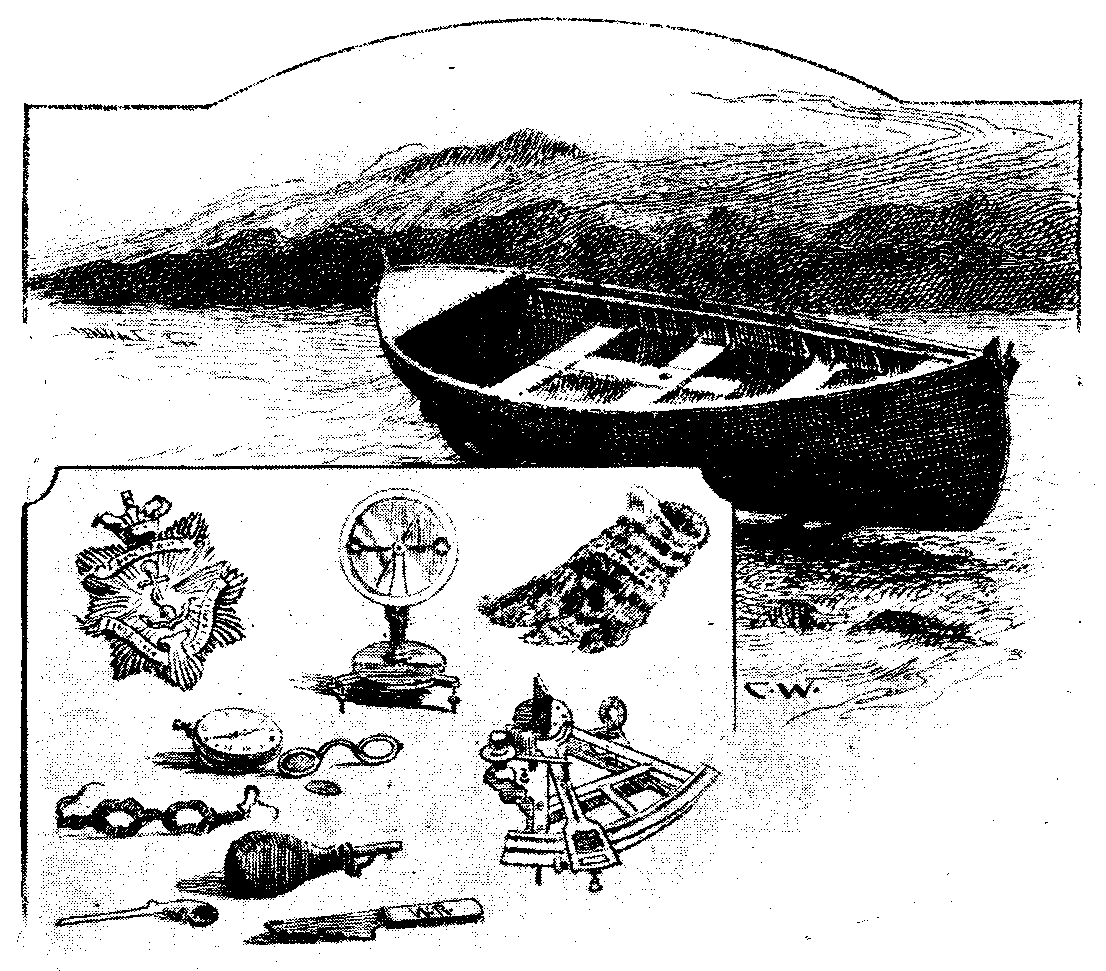
I really don´t know, but if that thing is true, it could explain why so many of this items were found among the belongings of the bodies of the men scattered in King King William Island. If some officers incurred on heavy and disproportionate expenses to afford this purchase, perhaps some of them succumbed to the temptation of carrying those valuable spoons and forks till the end.
And now I have found an astonishing thing. James Reid says:
"Lady Franklin has ordered all the officers' likenesses to be taken, and mine among the rest, with my uniform on. She keeps them all by herself."
My knowledge of English is well known to be insufficient, but I believe this phrase means that it was Lady Franklin who ordered the famous pictures (daguerrotypes) of the officers to be taken by Richard Beard? I didn´t know that detail. I have always read and believed that the idea have come from
John Franklin himself. Perhaps Reid was wrong, and was actually Sir John the promoter of such historical action.
The letter continues and then arises another remarkably assertion which hurts for the hidden true it contains and for the sincere love it shows to his beloved wife:
"Keep your heart up. We will both meet again. This voyage will be the last that I will never make."
The next letter was written 80 miles west from Stromness and it show us how this old lad was indeed loved by her employers:
"The first lieutenant calls me his Jolly Old Hero.' He is a good seaman, and so is Capt. Fitzjamcs. He is a fine man, and is next to Sir John Franklin."
Writing from Whalefish Islands in july 1845 he confirms the suggestions that Sir John was in a poor state of health when they departed from London, and that surely the fresh air of the sea had helped him to recover:
"I am glad to acquaint you
that Sir John Frankin is quite well, and
enjoying better health than when in
London"
References to the unusual warmth of the present and the previous seasons are done a couple of times, one mentioning that the previous season the winter was defined by the locals of Greenland as "mild" and other is this:
"I have been a number of 'years in this country, but I never saw it so warm as it has been during the past three days."
I don´t know why but James Reid always had attracted my attention, there was something in his look and posture who inclined me to feel certain fondness to this man.
James Reid left a wife and three sons, who he demonstrated through his writting he loved more than anything else in the world. The apparently rough and veteran seaman had a story behind, a story which was shared by other members of the crews. He had a live, family and friends. He, and the other members of this expedition, abandoned them all forever in the pursuit of a dream.
Good journey "Jolly Old Hero" I sincerely hope we could meet each other someday.










.jpg)