KABLOONAS

KABLOONAS
Burial of John Franklin. Author: me

KABLOONAS

Kabloonas is the way in which the Inuit who live in the north part of Canada call those who haven´t their same ascendency.

The first time i read this word was in the book "Fatal Passage" by Ken McGoogan, when, as the result of the conversations between John Rae and some inuit, and trying to find any evidence of the ill-fated Sir John Franklin Expedition, some of then mentioned that they watched how some kabloonas walked to die in the proximities of the river Great Fish.

I wish to publish this blog to order and share all those anecdotes that I´ve been finding in the arctic literature about arctic expeditions. My interest began more than 15 years ago reading a little book of my brother about north and south pole expeditions. I began reading almost all the bibliography about Antarctic expeditions and the superknown expeditions of Scott, Amundsen, Shackleton, etc. After I was captured by the Nansen, Nobile and Engineer Andree. But the most disturbing thing in that little book, full of pictures, was the two pages dedicated to the last Franklin expedition of the S.XIX, on that moment I thought that given the time on which this and others expeditions happened, few or any additional information could be obtained about it. I couldn´t imagine that after those two pages It would be a huge iceberg full of stories, unresolved misteries, anecdotes, etc. I believe that this iceberg, on the contrary than others, would continue growing instead melting.


lunes, 8 de diciembre de 2025

I THINK THIS SOUTHERN LAND TO BE A CONTINENT

Reading "The Voyage of the Discovery" by Robert Falcon Scott, I started to become intrigued about who actually was the first on landing on the Antarctic continent. What I believed, so far, was that the first on doing that were the members of the norwegian whale cruise "Antarctica", to which Carsten Borchgrevink had joined in 1894. However,  after digging for a while, I have discovered that there were others before him who could have been the first.

The existence of Antípodas was an ancient belief that an important mass of land had necessarily to exist to balance the known land in the north.  This theory apparently was originated by Aristóteles and inherited by the cartographer Ptolomeo.

A "Temperata Antipodunobis Incognita" land appears in the lower part of a map published in the 1483 reproduction of Neoplatonic commentary, a work by the 5th century roman Philosopher Macrobious. which included many excerpts from "Somnium Sciponis" by Cicero, who believed there was a land south of the indian ocean which he called "cingulus australis"

Published in 1483

This belief was adopted by subsequent geographers who also included this land in their maps like it is believed that Piri Reis did in his map in 1513, though it hasn´t been enterily proved that what he depicted in that map was actually Terra Australis:


After, when a great part of the world was by then already known, other cartographers like Johannes Schoner (1520), Oroncio Fineo (1536), Abraham Ortelius (1570), Rumold Mercator (1587), Johannes Kepler (1627) and Jodocus Hondius (1618) kept on drawning a huge land mass at the bottom of their maps with the name of "Terra Australis" reaching high latitudes.

1570 map by Abraham Ortelius depicting Terra Australis Nondum Cognita (transl. The southern land yet not known) as a large continent on the bottom of the map

It was not until James Cook second voyage (1772‍–‍1775), when Antarctic circle was crossed several times. Cook brought home word of several facts which, quite the opposite to discourage others to venture on those waters, would impulse the exploration of southern seas in the following years.

First, it was demonstrated that there was no land at the latitudes that Terra Australis was supposed to be, something which confused geographers of the time. Second, that it was possible to sail at southern latitudes that formerly was thought possible but also that there was an ice barrier apparently impossible to cross. And third, and mainly the main reason for what followed, the expedition brought news about the abundance of whales which plagued those regions. So it wasn´t, then, curiosity or a spirit of exploration which actually drove civilization to the discovery of the famous and elusive frigid continent, but the high demand of whale oil and possibly furs which reached its peak in the nineteenth century

So, it is not a surprise that it wasn´t till the beginning of the nineteenth century that mainland was actually seen for first time below the Antarctic circle. The fuel which proppelled whalers and sealers to the south was the same that push them through the north shores of Baffin Bay and through the entrance of the Northwest Passage.

It is not completely clear to me who was the the first on seeing the Antarctic continent. It is said that it could have been Fabien Gottlieb Bellinghausen during the first Russian Antarctic expedition (1819-21) who, on board the ships Vostok (which name would be given to the Russian Antarctic base), and the Mirny, saw allegedly the Antarctic continent the 27 of febreruary of 1820. But other sources give the merit to Edward Bransfield who together with William Smith, landed in South Shetland islands and soon after, the 30th January of 1820, saw the Antarctic continent. 

Apparently, after the discovery of South Shetland islands by William Smith a year before in 1819, the archipielago soon become a base for whaling expeditions coming from Britain and America. It seems that Yankee Harbour and deception island offered them particularly good shelter for their flotillas during the following years. The next season of that same year 1819 that William Smith and Bransfield returned to the islands there were two more ships in the area, the american whaler Hersilia and Espirito Santo from Buenos Aires. Months later, on November 17, 1820, Nathaniel Palmer, also saw the continent while looking for new hunting grounds on board the auxiliary sloop Hero. Journals of Espirito Santo were not conserved so it is impossible to ascertain if they could have visited the continent too. 

But none of these expeditions landed on the mainland, it would take almost a year after the first sighting of Antarctica land till someone left the first human print in the continent. Here, it is necessary to mention the fact that ship of the line, St Telmo, with more than 600 people on board, was supposed to have shipwrecked on 2nd September 1819 in Livinstong island, being then the first on unwillinly "land" on South Shetland islands shores though, if that was true, no one lived enough to tell the story.

Let´s see the chronology of landings and some other prominent explorers who had an important role in the discovery of the continent:

John Davis sealer First landing on Antarctica (7 february 1821)

There were several John Davis involved in the discovery of polar regions. John Davis the ancient mariner who discovered Falkland islands and penetrated Baffin bay till discover the gates of the Northwest Passage, John Edward Davis, who accompanied James Ross in his Antarctic expedition, John King Davis, chief of the Nimrod who accompanied Shackleton and a surprising one, John Davis an American sealer, who apparently was the first on landing the 7th of February 1821 on the Antarctic continent. 

John Davis was captain of the ship Huron which was accompanied by Christopher Burdick. captain of the Huntress. It is not a surprise that one of these whalers decided to explore if there was land south of South Shetland islands since the continent is not really that far from them.

In 1955 the document "The voyage of the Huron and Huntress" published a very intersting narration about the events which surrounded John Davis landing in Antarctica and gives a very intersting historical context to it. The journals of the ships Huron and Huntress were found in 1952 by Alexander O. Victor, Curator of Maps at Yale.

The book highlights the role of whalers and sealers in polar the exploration of Antarctica. From it I have excerpted some paragraphs that give a good idea about who actually where the real discoverers of those far shores:

"It Is with the voyages of these mariners among the South Shetland Islands that we are herein chiefly concerned. On this fringe of Antarctic seas, they established camp and rendezvous, sailing through the Ice-filled channels and along the rocky shores of the desolate islands; here they lived incredible lives, plundering the rookeries and exterminating the seal. And here they braved the unknown dangers of the icy, uncharted waters to the south, becoming the first among men to sight, recognize and land where rise the snowy mountains of the last great continent—Antarctica."

Apparently, after news have spread about these new hunting grounds, South Shetland islands were invaded by ships and schooners during the summer season of 1820-21. Among them, John Davis, whose season wasn´t been as good as he had expected in the archipielago, took a decission which will bring him to the glory of being a "first".

 The season was finishing and they needed to fill their holds before returning home. If there was any spirit of exploration, it must have been well buried under the more powerful spirit of hunting:

". , . Concluded to make the best of our way for our People that is sta- tioned on the South Beach, and then to go on a cruise to find new Lands, as the Seal is done here . . ."

John Davis started to sail south, southwest jumping from island to island hunting on all those which wasn´t previously occupied by other sealers. From Smith island to Low island and from Low island to Hoseason Island, 20 miles off Hughes bay in the Antarctica peninsula. From here, the final leap to reach te continent was the obvious following step to follow and they made it.

Here, I prefer to paste the description of this historical episode from the  The voyage of the Huron and Huntress as it includes the original Davis´s log entries from which I decided to inspire the title of this post and which the author of the paper also decided to name a chapter:

"I THINK THIS SOUTHERN LAND TO BE A CONTINENT"


There are no pompous words, no greetings nor historical remarks, just a sober tone from which one can deduce certain irritation when Davis states "no signs of seal" before mentioning, as if it wasn´t important, that he thinks he has landed in a new continent.

But now there is the question about who actually were the individuals who landed in the continent. It has been to John Davis to who the credit was given, as commander, but it is likely that it wasn´t him who landed phisically in Antarctica but some of his mates, Charles Philips and Smuel Goddard from who nobody likely have heard a word ever and those sailors who took the oars.

From the book:

"The historic moment of the landing was between 10:00 and 10:30 o'clock that morning: "Out Boat and sent her on shore to look for Seal." This was his main purpose, not recording the lay of the land, taking soundings or notingshore characteristics. The whaleboat returned at 11:00 o'clock and no seals were found. Who were the men taking part in this historic landing? This will probably never be known. Mate Samuel Goddard of the Huron was on boardthe shallop. As he and his second mate, Charles Philips, with second mate Smith of the Huntress had gone ashore exploring Low Island, it is very probable that those same officers and a boat's crew took part in this landing. Thus, they presumably were the first human beings to step on the Antarctic Continent."

As it used to happen in the history of Polar exploration (and in history in general), particular individuals participating in glorious events are not remembered, just their leaders. 

But, once clarified who were the first, it is interesting to analyze other historic subsequent landings which followed Davis, though not in the continent necessarily, like the one made by James Clark Ross in Possession island. 

James Clark Ross 1841

It is very interisting and strange the fact that, in spite of being one of the expeditions which more extensively and thoroughly explored the shores of Antarctica, making impressive discoveries like mount Erebus and Terror, the Ross ice shelf, etc., Ross didn´t land in the continent. He was pretty close, though, when he landed in Possesion island. A superb painting depicts this historical moment, but more superbly is his account of that day.


"...inconceivable myriads of penguins completely and densely covered the whole surface of the island, along the ledges of the precipices, and even to the summits of the hills, attacking us vigorously as we waded through their ranks, and pecking at us with their sharp beaks, disputing possession ; which, together with their loud coarse notes, and the insupportable stench from the deep bed of guano, ..., made us glad to get away again"

According to James account, that wasn´t the best place to land, but he was terribly close to do it.

"...there was a strong tide running to the south, between Possession Island and the main land, and the Terror had some difficulty to avoid being carried by it against the land ice. Future navigators should therefore be on their guard in approaching the coast at this place."

I read James Ross narrative of the voyage long time ago so and I don´t remember another occasion on which they could have risked to land.

From Ross we jump to the story of another whaler, Mercator Cooper.

Mercator Cooper 1851

Ten years after, another interesting character appeared into scene. This again was a whaling-sealing cruise (Levant) which led a man with the surprising name of Mercator to land in Oates´s land. Wikipedia wrongly states that Mercator was the first "visitor" of Antarctica. 

The log of this whaling cruise is digitalized and available here.


And finally, we find Carsten Borchgrevnik, who later would command the Southern Cross expedition and who was for some time believed to be the first on landing on Antarctica:

Carsten Brochgrevnik 1894

He joined the  norwegian whaler Antarctica in 1894, landed first on Possession island (following Ross´s steps) on 17 January 1895, explored and later landed in the continent, as it is described in "The cruise of Antarctica to the south polar regions" by Henrik Johan Bull.

While reading his narative (among miriads of mentions to the absence or presence of whales),  I couldn´t avoid to extract this passage with made me feel curious about his true personality:


They kept on sailing south and then decided to come back north. When they passed Cape Adare again, they decided to land:

"January 24. — Cape Adare was made at midnight The weather was now favourable for a landing, and at 1 a.m. a party, including the Captain, second mate, Mr. Borchgrevinck, and the writer, set off, landing on a pebbly beach of easy access, after an hour's rowing through loose ice, negotiated without difficulty. In the calm weather little or no swell was observable against the shore. ...."

Then it comes anoter remark about the annoying lack of whales contrary to what Ross had described in his narrative of his journey to this part of the world:

"The sensation of being the first men who had set foot on the real Antarctic mainland was both strange and pleasurable, although Mr. Foyn would no doubt have preferred to exchange this pleasing sensation on our part for a Right whale even of small dimensions"


And then it comes an interesting reflection:

"Our presence was not much appreciated, considering the millions of years which must have elapsed since the last visit by prehistoric man or monkey — before the glacial period. Our seaboots were bravely attacked as we passed along their ranks."

And then a pole was erected and a box was left which I wonder if it is still there or if someone found by other expeditions:

"To commemorate our landing, a pole was erected, carrying a box, on which was painted the Norwegian colours, the date, and the vessels name.


"Before leaving we made a collection of penguins, stones, etc. Someone had the good sense to bring a sledge-hammer, with which pieces of the original"

These weren´t the only ones on taking a "sample" of penguins with them, Ross and others had that mania too.

No land animal like the Arctic bear has ever been observed by any Antarctic traveller — the * mysterious tracks in the snow,' etc., mentioned by one of our number were not observed by anyone else at the time — and certainly the possibility of finding Antarctic nations, etc., is too imbecile to require serious discussion.

"We bade farewell about 3 a.m. to those of our hosts which we did not take away with us for a trip to natural history museums, and passed two very anxious and troublesome hours before regaining the vessel, as they had omitted to keep a look-out for us on board. We thus had the pleasure of seeing the shijp working in towards the land in one direction, whilst we were compelled by the ice to take an opposite one. By shouting in chorus we at last attracted attention, and saw the course altered towards us."

Bull ends his description of the land he visited reporting that the bay at Cape Adare would be a perfect place to land and to stablish a base. This would be the place chosen for Carsten Borchgrevnik to winter during the Southern Cross expedition.

There is an interesting article about this landing here which shows a wonderful picture of both men.

Bull and Borchgrevnik may be not be the first on landing on Antarctica but definitely were the ones who opened the gates to the discovery of its interior soon after in 1897 by the Belgica expedition and after in 1898 by the Southern Cross expedition, both the first on wintering in the Antarctic regions.

miércoles, 1 de enero de 2025

WAS THE BRITISH ARCTIC EXPEDITION THE PRELUDE OF SCOTT´S TRAGEDY

The British Arctic Expedition led by George Nares during the years 1875-76 has perhaps always enjoyed an undeserved bad fame. It is commonly known as an expedition on which scurvy caused devastating effects in the health of the crews on board the ships Alert and Discovery, an expedition where four men died, three of them of scurvy. 

The four men were:

    - Niels Christian Petersen - Dog driver and interpreter (Severe frostbitten followed by gangrene, 14 May 1876)
    - George Porter - Gunner (Scurvy, he collapsed while sledging 8 June 1876)
    - James Hand - A,B- (Scurvy 13th june 1876) 
    - Charles Paul (Scurvy, he collapsed while sledging 29th june 1876)

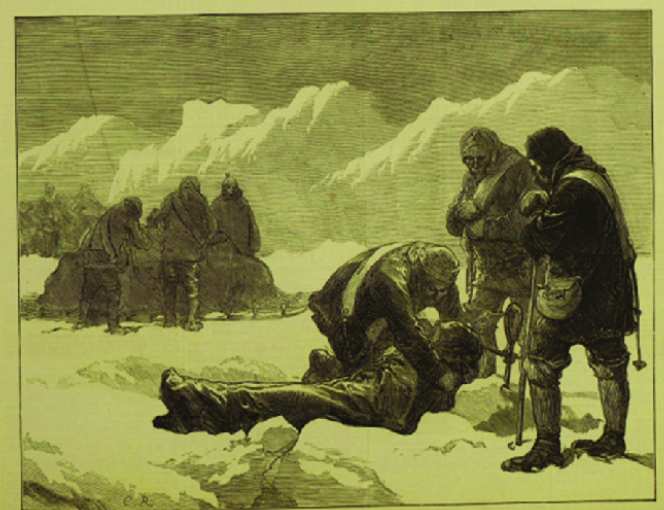
A funeral in the ice

Though Nares was a veteran of Edward Belcher´s expedition (1852-54) in search of Franklin, and surely knew well the risks of a polar confinement, he didn´t know how to fight the sickness properly. Apart from those who died, much more men were affected by this plague, only their early return after just one winter in the north spared their lives. The fact that the deaths happened during the summer exploration journeys which followed the long and cold winter night seems to underline the fact that physical exercise only worsened the health of those affected by scurvy. 

Alert in Winter Quarters Floe Berg Beach

The expedition was also criticized for not having made any significant geographical discovery when they were intended to reach the North pole. Nares had apparently forgot the lessons which some other explorers, like Leopold McClintock, had learned about the use of dogs, snowshoes and the building of igloos from the Inuit during all the years that the Franklin search took place. Manhauling heavy loaded sledges was the prefered choice instead of the use of dogs which they have bought in Greenland and that likely was the decission which indirectly killed Porter, Hand and Paul. 


Nares, plan was to follow Polaris expedition (1871-73) steps led by Charles Francis Hall, which consisted on trying to reach the North Pole sailing first north by Smith sound, setting winter quarters at the northernmost possible latitude and then crossing the ice cap towards the top of the world on foot dragging massive sledges from the north shores of Greenland or Ellesmere island.

Instead of serving as an example about "what not to do in a polar expedition", Nares´s expedition was the reference which Clements Markham (who accompanied the expedition till Disko Bay) decided to follow years after when he, as president of the Royal Geographical Society, planned Scott´s expedition to the South Pole, paving the path to the tragedy which would swallow Scott and his four companions in the Antarctic more than thirty years after.

George Henry Richards, Hydrographer of the Admiralty, shows his enthusiasm about the question of sledging and manhauling in the arctic regions in the Introduction of his Narrative when talking about the search of Erebus and Terror:

"Again, the search for the missing ships involved the minute examination of a vast extent of coast-line, which neither ship nor boat could approach, and this task could only be accomplished by the manual labour of dragging heavily laden sledges along the margin of the frozen sea for weeks or months together. The art of sledge-travelling in this manner was initiated, and perhaps brought to the highest state of perfection it is susceptible of, during the progress of this long search. As much as four hundred miles in a direct line on an outward journey had been accomplished by these means, each man dragging between two and three hundred pounds, including his provisions, clothing, and equipment, and being absent from the frozen-in ships frequently from ninety to a hundred days. It was manifest, then, that if such distances could be accomplished in search of men in distress, they could be equally well performed in the pursuit of geographical discovery".

But the Hydrographer was wrong, so was Nares who underlined Henry Richards views. McClintock had used 29 sledge dogs guided by a different Petersen during the Fox expedition of 1856-57. The use of dogs, the fastest and efforlessly way of travelling on ice and snow, was the proper way to perform any geographical discovery with surgery precission. McClintock and Hobson´s teams were so succesful precisely because they made an intensive use of dogs and built snow huts (igloos) to protect themshelves against the elements and the killing temperatures and lived off the land hunting and fishing when it was possible.

But not all of these critics are enterily justified. Actually, dogs were used in the expedition. Fifty five dogs were bought in Greenland (30 dogs were carried on Alert´s deck and 25 in the Discovery). Besides, some discoveries were made and some records beaten. They were the first on wintering at such high latitude (82º 17´), beat the previous record set by Hall´s expedition by a whole degree north reaching 83º 21' (that would last only six years before being beaten again by the Greely expedition for a magre new mark of two minute more) and there were also some heroic episodes worth of being rescued from the narratives of the expedition to be told here. 

Albert Hastings Markham, second in command of Alert, cousin of the aforementioned Clemments, led the party aimed to reach the North Pole which abandoned the ship in april of 1876. Markham had some previous polar experience after having been second mate in the whaler Arctic a couple of years before sailing with Nares. 

Markham later would write his own account of the voyage, from where we can surprisingly see his opinion about dog sledging:

"From six to ten or a dozen dogs form a team. They are capable of dragging as much as one hundred and fifty pounds per dog; but this is rather an excessive load and should not be exacted for any length of time. So strong and enduring are they that they will frequently perform a journey, over smooth ice, of twenty-five or thirty miles a day with this load; but with light loads and level ice they have been known to travel as much as seventy and even a hundred miles in one day."

But in spite of having them on such a high regard, Markham didn´t used the dogs. Nares and him considered them just an auxiliary mean of support and not the principal engine which could led the expedition to the glory. Scott himself would do the same thing years later. He didn´t built snow huts neither, disregarding McClintock´s succesful experiences. Tents can´t protect the explorers against strong gales, as Markham had learnt during the autumn explorations along the north shore of Ellesmere island. His analisys starts enumerating all the disadvantages involving the use of dogs:  

"But when obstacles such as hummocks and deep snow-drifts have to be encountered, especially with a low temperature, the reverse is the case. Directly the sledge receives the slightest check from either of these causes, the dogs lie down, and look at you in the most provoking manner. It is no use having recourse to the whip, for not all the flogging in the world will make them advance until the obstacle has been removed, or the sledge carried over the difficulties that had retarded its progress"


And ends with a categorical judgement, perhaps sentencing those who accepted his advice to a sure failure in the subsequent expeditions:

"Another very annoying and distressing piece of work connected with dog sledging is clearing the lines, which in a short time become in a grievously entangled state from the constant dodging about of the dogs, and this it must be remembered has to be done with hands encased in thick woollen mitts, for to bare them would ensure serious frost-bites. In consequence of the amount of provisions that have of necessity to be carried for the use of the dogs, it is almost impossible to use them for long journeys. None were employed during the expedition by any of the extended sledge parties; but for short journeys, or when dispatch was required, they were invaluable."

The discussion about the use of dogs and other inuit techniques could fill a book, it is not my intention to start a debate here bout the question, but it is true that sometimes, we polar history enthusiasts have a trend to forget facts. Expeditions in the nineteenth century used dogs, though not always as the main mean of transport as they should have been used, but it is also true that more contemporary explorers, who we consider heroes like Shackleton, during his attempt to reach the south pole didn´t use them neither and are not blamed for it because they survived.

In september, once the Alert was anchored in his definite winter quarters, the exploration of the north coast of Ellesmere started. A party led by Aldrich ...:

"... was despatched with three men and two dog-sledges, provisioned for fourteen days, as a sort of pioneering expedition ; his orders being to proceed, if possible, as far as Cape Joseph Henry, there to erect a cairn and deposit a record with full information regarding the practicability of travelling, that would be of use to the main party which would follow him in a few days."

The main party formed by Markham, Parr and May departed three days after in three sledges, called Marco Polo, Victoria and Hercules respectively, dragged each by eight men carrying 90 kg each: 

"Our provisions were all carefully weighed and packed ; the maximum weight dragged by each man on leaving the ship was 201 lbs., decreasing at the rate of 3 lbs. per diem due to the consumption of provisions. The slight experience that we obtained during the previous few days' sledging stood us now in good stead; the men who had recently been so employed being regarded as veterans in sledge work by those who were for the first time being initiated into its mysteries"

It is a pity that Markham doesn´t compared both experiences, one could think that the outcome was so different that he intentionally wanted to conceal any comparison: 

"I make no apology for not entering more fully into the journeys performed by Aldrich and others, as the description of one sledging expedition suffices for all, and I am, of course, best able to describe those in which I was myself personally engaged."

That autumn exploration had to pay an expensive toll for just the 40 miles they covered in nineteen days. The toes of several members were amputated from their feet because of frostbitten once back to the ship. Among them the big toe of Lietuentant May. 

In his narrative, Markham described the proceedings of the northern party without any self-critical thought. It was formed by 53 men and officers and seven sledges, some of which were intended to return before abandoning land. Two boats were carried on two of them. They departed the 3rd of april 1876, quite early in the season. 


That wasn´t a regular sledge journey, but a constant battle against the ice since the very moment they put a foot on the frozen sea. In words of Markham:

" It seemed as if a terrible conflict had been fought between these ponderous masses of ice, which had so shattered and split them up as to suggest to us the idea that they resembled a tempestuous broken sea suddenly frozen."

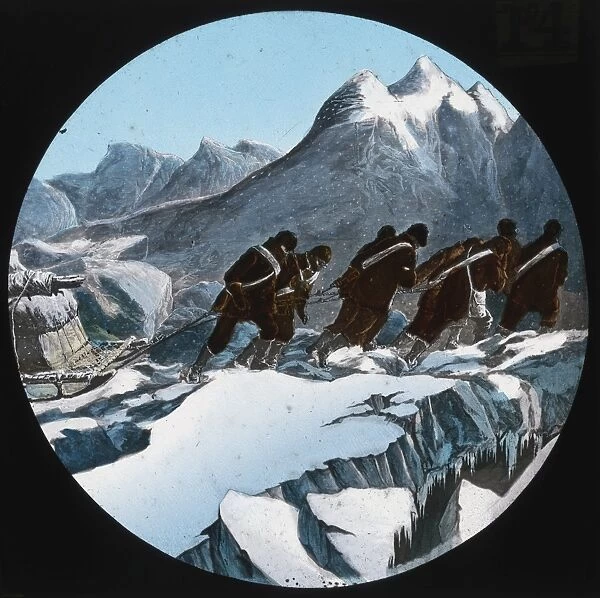
Even in this magic lantern slide is visible the huge size and load of the sledges

Markham bore the hope that once they got far from the coast, the ice would become smoother and flat but that didn´t happen. They travelled during the night in order to avoid snow blindness making a snail-like progres, as Markham, called it. That would be the norm during the whole journey since they had to deal with pressure ridges fifteen meters high or more. Parry had had a similar experience fifty years before, he had been told that a cart could have been driven by a flat surface, dragged by reindeers, like in a highway, to the very north pole but there wasn´t any highway there. They had to cut their own way with their iceaxes exactly as Markham had to do. As he named it, they had to do the "Road-making".

Among the men who formed that party there was one who shone particularly among the others;

"Parr with pick- axe and shovel was a first-rate navvy," and worked like a horse."

"... large masses of ice thickly compacted together, squeezed up into every conceivable, but indescribable, shape and form to a height of about twenty-five feet; but these had to succumb to the strenuous exertions of Parr and his indefatigable road-makers"

But after two weeks of hard work, the scurvy showed up and got a deadly grip on almost the whole party. The terrain didn´t help neither so some of the men started to be unable to keep on dragging the sledges and had to be even carried on them. 

By then, it was known that fresh meat and vegetables were effective against scurvy, but apparently the explorers weren´t able to secure it hunting to fight against the illess. Markham concludes that it was the absence of light, and the long confinement due to their wintering at higher latitudes than other expeditions, was the main cause. 

It was the 20th of april and Markham, though complaining continuosly in his journal for the decreasing manpower and the extra weight the sick men meant, didn´t appear to think on returning to the Alert. It wasn't till 20 days after, the tenth of may, when he decided to turn around. In his narrative, Markham explains that he made up his mind because of the fact that: five men were completely useless,  there were incresasing symptoms which the rest of the men were showing and besides, they only have provisions for 30 days for a retourning journey which was supposed to last 40.

"This 12th of May must always be regarded as an eventful day in the lives of our little party, for it was that on which we had the honour, and no small gratification, of planting the Union Jack on the most northern limit of the globe ever attained by civilized man, or, in fact, so far as our knowledge goes, by mortal man !"


Captain Markham's most northerly encampment, by Admiral Richard Brydges Beechey

Scurvy has the effect of decreasing the apetite of those who suffered it, in part, because of the pain which it produces in the sored gums, so the health of the men worsened exponentially. Fifteen days after, the party hadn´t reached land yet and desperate measures had to be taken:

"On the 27th the condition of the party was so critical that it became only too painfully evident that, to insure their reaching the land alive, the sledges must be considerably lightened in order to admit of a more rapid advance. The state of the party was on that day as follows: five men were in a very precarious condition, utterly unable to move, and consequently had to be carried on the sledges ; five others nearly as bad, but who nobly persisted in hobbling after the sledges, which they could just manage to accomplish, for, as the sledges had to be advanced one by one, it gave them plenty of time to perform the distance ; whilst three others exhibited all the premonitory scorbutic symptons. Thus only the two officers and two men could be considered as effective ! This was, it must be acknowledged, a very deplorable state of affairs"

 This was the moment where  lieutenant Alfred Arthur Chase Parr, came again into scene. The sledge was 30 miles far from the ship in the depot left the previous autumn on the way to Cape Joseph Henry. A message left in the cairn said that a dog sledge party has left the depot just two days ago, so they couldn´t expect another relief party coming soon. The situation was quite desperate and Parr was the stronger man, the only who still kept some strength and which could serve of some help. For the whole party it would have taken three weeks to reach the ship. The only way to avoid the explorers to end like the Franklin expedition retreating men, was to send the strongest man in search for help.


It was a bold chess move, the risks were too high. The history of Arctic exploration is full of examples of men who disappeared forever while traveling alone in the wilderness. A day after Parr left the party, the 7th of june, Porter died. 

Not far from the depot left by the expedition the past autumn, what we supposed a swallow grave was dug: 

"Sad and mournful, indeed, was the small procession that wended its way slowly to the new-made grave, dug out of a frozen soil, carrying the lifeless remains of their comrade, covered with the Union Jack, on the same sledge on which he had been dragged, whilst alive, for many weeks ; and there, with the tears trickling down their weather-beaten and smokebegrimed faces, with their hearts so full as to choke all utterance, they laid their late fellow- sufferer in his last resting-place.

A rude cross, improvised out of the rough materials that our own equipment supplied, with a brief inscription, marks the lone and dreary spot in that faroff icy desert where rests our comrade in his long sleep that knows no waking, and where probably human foot will never again tread."

" O World ! so few the years we live, Would that the life that thou dost give

Were life indeed ! Alas ! thy sorrows fall so fast, Our happiest hour is when at last

The soul is freed." 

An sketch of Porter´s grave painted by the surgeon Edward Moss Lawton:

 THE MOST NORTHERN GRAVE
A LITTLE mound of ice on the side of a floe-hill, and a rough cross made of a sledge batten and a paddle, mark our shipmate's grave — the most northern of any race or time.

It was the 9th of june, a day after Porter had died and buried, when ironically, a dog sledge from the Alert shew up:

"...gradually emerging from the hummocks, a hearty cheer put an end to the suspense that wTas almost agonizing, as a dog-sledge with three men was seen to be approaching. A cheer in return was attempted, but so full wrere our hearts that it resembled more a wail than a cheer."

It took Parr a day to reach the ship and the rescue party another to come to rescue. More dog sledges came a day after and four days later, 14 of june, Parr's birthday, the whole party excepting for Porter, arrived to the ship.

Parr was a hero, however, Markham, again forgets to dedicate him a whole chapter, which is the lesser thing he deserved, in his book. He had saved the life of the remaining thirteen men from the northern party, including Markham´s one.

Nares, was more generous and recognized in his letters his bravery:

"Lieutenant Parr, with his usual brave determination, and knowing exactly his own powers, nobly volunteered to bring me the news, and so obtain relief for his companions.

Starting with only an Alpine stock, and a small allowance of provisions, he completed his long solitary walk, over a very rough icy road deeply covered with newly fallen snow, within twenty-four hours."

It is not mentioned in Nares notes that the forced march was performed by a dog sledge: 

By making a forced march the two latter, with James Self, A.B., reached Commander Markham's camp within fifty hours of the departure of lieutenant Parr, although they were, T deeply regret to state, unfortunately too late to save the life of George Porter, Gunner, R.M.A., who only a few hours previously had expired and had been buried in the' floe"

Parr could have perfectly vanished and form part of the long list of polar casualties, securing a pin in my Arctic graveyard map but he survived and had still a long career after this adventure.

I was lucky enough to find a couple of good pictures of him. Parr died at the early age of 65 but left three daughters who had a long life. Robert Falcon Scott, during the Antarctic expedition of 1901-02 named a Cape after him. From the discovery of this cape, I have learnt that again, ironically, apparently, Parr was one of the Robert Falcon expedition advisors...


NOTE;
As a curiousity, while analising the huge amount of material available on line about this expedition I found a singular ghostly apparition. In the picture which shows the "Invalids" from the expedition, there is a bizarre face, wearing a polar hat, what looks like looking right to the camera lens showing his tongue in a mocking gesture.
My dear friend Glenn Marty Stein, who has a copy of this picture told me that the description of the pictures says it is actually a mask for protection against the elements. Others think the position of the holes for the eyes are too separated. It would be interisting to know your opinion about what this possible could be. 


References:

Results derived from the Arctic Expedition, 1875-76. I. Physical observations by George Nares and [H.W.] Feilden II. Medical report on the Eskimo dog disease, by B. Ninnis : Great Britain. Arctic Expedition 1875-6 : Free Download, Borrow, and Streaming : Internet Archive

Narrative of a voyage to the Polar Sea during 1875-76 in H.M. ships 'Alert' and 'Discovery' : Nares, George S. (George Strong), 1831-1915 : Free Download, Borrow, and Streaming : Internet Archive


The great frozen sea : a personal narrative of the voyage of the "Alert" during the Arctic Expedition of 1875-6 : Markham, Albert Hastings, Sir, 1841-1918 : Free Download, Borrow, and Streaming : Internet Archive


The Arctic expedition of 1875-6 [microform] : compiled from official sources with a summary of previous adventures in the Arctic seas : Johnston, R. (Robert) : Free Download, Borrow, and Streaming : Internet Archive

Shores of the polar sea : a narrative of the Arctic expedition of 1875-6

https://archive.org/details/b21356919/page/n3/mode/2up