KABLOONAS

KABLOONAS
Burial of John Franklin. Author: me

KABLOONAS

Kabloonas is the way in which the Inuit who live in the north part of Canada call those who haven´t their same ascendency.

The first time i read this word was in the book "Fatal Passage" by Ken McGoogan, when, as the result of the conversations between John Rae and some inuit, and trying to find any evidence of the ill-fated Sir John Franklin Expedition, some of then mentioned that they watched how some kabloonas walked to die in the proximities of the river Great Fish.

I wish to publish this blog to order and share all those anecdotes that I´ve been finding in the arctic literature about arctic expeditions. My interest began more than 15 years ago reading a little book of my brother about north and south pole expeditions. I began reading almost all the bibliography about Antarctic expeditions and the superknown expeditions of Scott, Amundsen, Shackleton, etc. After I was captured by the Nansen, Nobile and Engineer Andree. But the most disturbing thing in that little book, full of pictures, was the two pages dedicated to the last Franklin expedition of the S.XIX, on that moment I thought that given the time on which this and others expeditions happened, few or any additional information could be obtained about it. I couldn´t imagine that after those two pages It would be a huge iceberg full of stories, unresolved misteries, anecdotes, etc. I believe that this iceberg, on the contrary than others, would continue growing instead melting.


domingo, 4 de noviembre de 2012

ARTICT LIVING HAZARDS

The arctic is a dangerous place, the main enemies you can find are the weather conditions, the extreme cold, strong gales and winds, icebergs, the tramps  of ice  for ships in the straits, etc. but,  other dangers walk and run over the ice floes and over the ground and have been also, a lot of times,  a cause of tragedy since the beginnings of the exploration.

Reading the book writen by Frederick William Beechey "A voyage of discovery towards the North Pole", about the expediton towards the North Pole commanded by David Buchan, it is curious how he mention an accident, or a tragedy depending on the point of view, which happened to William Barents during his second voyage near Nova Zembla.


Frederick William Beechey : From the wikipedia.
 In this narration, which have captivated me since the moment on which I read the first pages, Frederick tells how the crew of Barents were attacked by a polar bear. In the course of an exploration party in order to find some "diamond like" stones, two of the men were lying on the ice resting, then a polar bear appeared and caught one of them by the neck. The poor man, unaware of that he was being attacked by a huge polar bear shout: "Who is it that pulls me so by the neck?"· that were his latest words, a moment after the polar bear bit his head. The other mate run away and the rest of the men on the ice, twenty in total, came to his aid.
 
Though they carried their charged weapons and their pikes prepared, they were attacked by the bear which caught another man. The death of this second man is lively described by Barents as follows "...which she (the bear) tore into pieces", an awful death. The men run away after this attack.

Barents and other mates which were on the ships, took a boat and tried to encourage the crew to try to kill the bear, only four of them were brave enough to fight against her. They shot in her forehead between the eyes, and hit her with axes several times. The bear had the corpse of the man still on her claws, not was until a man hit strongly into her snout, that the bear finally fell and released the dead man.

Crew of the Barents´s expeditions against the Polar bear_From the wikipedia.


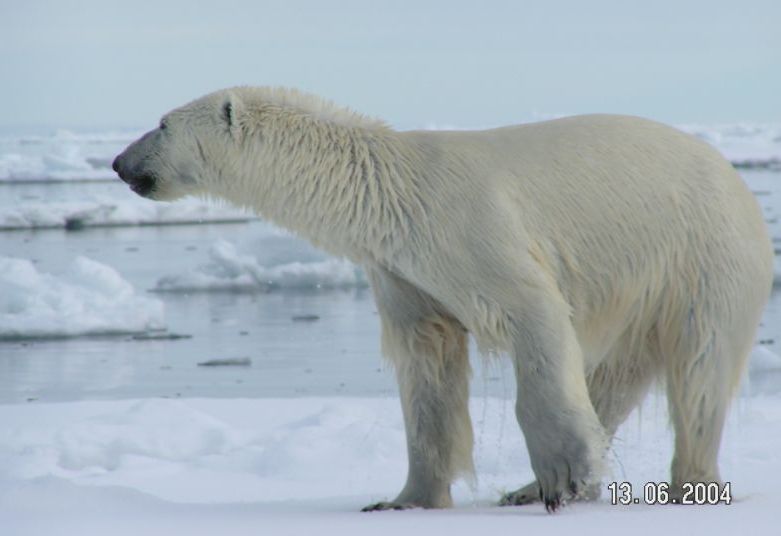
Numerous times we have heard about attacks or threats of this big, brutal, agressive but also strong, brave,  elegant and magnificient animals to the humans, even while Jhon Geiger  and Owen Beattie and were in Beechey Island a polar bear approach inadvertenly to the camp. The expedition of the Ingeneer Andree was supossed to be attacked by another bear, Nansen dealed with them several times in the course of his trip towards the North Pole.

Polar Bear_From the wikipedia.

In the end, the arctic is its natural place to live, we, the Kabloonas, are no more but invaders which from the point of view of the Polar Bear are no more than fresh, original and strange food which with no doubt must be of a remarkably bad taste. I think that they had all the rights to eat us if they consider it appropiate for the occasion.
martes, 16 de octubre de 2012

AN ELUSIVE TOMB FOR AN ILLUSIVE EXPLORER

Lorenzo Ferrer Maldonado still today is playing one of his final tricks, the alleged first discoverer of the North west passage is trying to elude me.


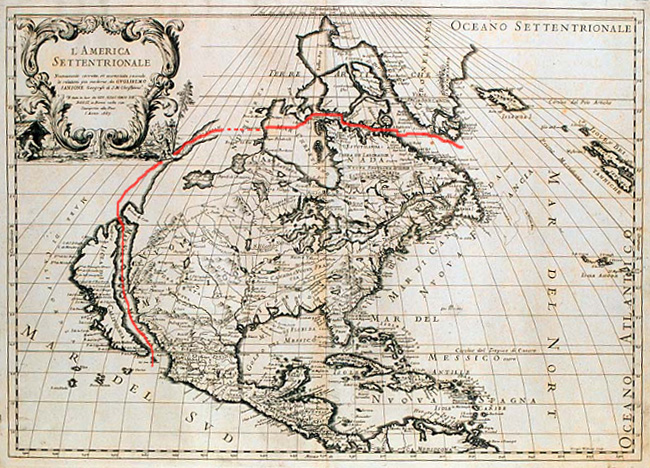
Course of the expedition of Lorenzo Ferrer maldonado.
http://www.todoavante.es/index.php/Ferrer_de_Maldonado,_Lorenzo
As his biography says Lorenzo Ferrer Maldonado died in Madrid, where he lived, in 1625, in a inn in the "Silva" Street and by fullfiling of his will he was buried in the church of the Ntra. Sra. of the parish of San Martín. Which is supossed to be in the Desengaño street.


StMartin(the new) c/Desengaño.
There are confusing information about his history, in some places I´ve read that he was living his final days in an inn and that the family "Henestrosa" (his family) had a chapel in the church of St.Martin the Tours of the Benedictines, which is placed in the text of the biography wrongly in the Desengaño street (wrongly because in that time there wasn´t any St Martin church there as we are going to read after). In other account I´ve read that because his house belongs to the church of St Martin (in that time placed in the St.Martin Square, now "The Descalzas" square) he was buried there.

Yesterday evening I went to the current place where it is the current St.Martin church to look for the covetted tomb, but for my dissapointment (due to my inexperience as researcher I act first, ask after and find nothing) I found nothing. I asked to a nun who was there and she said to me that the original church of St Martin (placed in the Descalzas square) was destroyed by order of Napoleon while Jose I Bonaparte was governing in Spain just to "make room" to new buildings. So, this new church of St Martin only wears the name and the tradition of the original church. This new St Martin  was occupied by this parish in 1836 and built some time before.

But... I am not absolutely sure that Lorenzo was buried in the original church of St Martin (in the Descalzas square) neither, because the inn where he lived his last years was very close to the place in which the new St Martin is but some far distance  from the original St Martin church of 1625 where he was supposedly buried. It could be a confusion if the byographer was refering to the place  of the burial by the name of the current church.

Monastery of the "Descalzas Reales", Descalzas square (before St martin church and square).
And, to complicate more the things, very close to the Silva street is the church of St Idelfonso, a temple constructed as a subsidary of the parish of St Martin from the Descalzas (the original), but...it was built in the years surrounding 1629, four years after his death but this date is not absolutely sure, a pity, it is in fact a good candidate to be the correct place but in this case with an uncorrect name.

The conclusion is that I am still trying to guess where his grave was placed, and if the tomb still exists, that means, if he was buried in the original St Martin church, his remains are likely lost forever or were placed in other site before the demolition, but if he was buried in the place where St Martin is currently situated, he wouldl be lost the same, because that nun said to me that the crypt was emptied in front of a notary after the new parish came to occupy it and that there weren´t any corpse in the crypt. And finally, if St Idelfonso was the place where he was really buried, then Lorenzo premeried a good place to stay forever, though, again the current church isn´t the original, so if this is the real place, the grave could have been lost again. (However I will go there to check it on the spot).

Fourtunately I have a friend specialized in the old Madrid, so I still have a chance to discover the correct place, thanks to him I discovered (more or less) where Lady Franklin slept when he was here in the Puerta del Sol, the missing "Hotel de los Príncipes".

sábado, 6 de octubre de 2012

THE MAN WHO ATE HIS BOOTS (THE BOOK)


At last I´ve finished the book of Anthony Brandt, I bought it in London without having read any review about it, (a risk if you consider the large amount of Franklin books available in the market) but the cover captivated me, and I fell into its claws. It has taken me so long read it because I began, soon after  beginning  to read it, reading at the same time "Arctic labyrinth" by Glyn Williams.

In my opinion this is a very good book to make yourself an idea about the different expeditions led by John Franklin and a lot more related. The book is full on transcriptions of the original narrations  of the voyages and, from my modest knowledge of english, it is well written, so that you can follow the neverending secuence of expeditions without being lost and without getting tired. However, I think that it lack of maps, hardly three or four maps in the whole text, helps you to find yourself in the arctic. A lot of geographical names which are mentioned don´t appear in the maps, so  you are unable to identify, without a near laptop to check the places, where exactly you are sailing or dragging a sledge. 

Another good thing is the summary of the expeditions that you can find at the beggining of the book, which also helps to check once and another who was the first on reaching and discovering each place and in what date. And finally, there is an unvaluable chapter called "Sources" on which the author reveals the sources of information of every part of the book which has been narrated, so you can get deep, if you are interested, on a particular part.

CONCLUSION: In my opinion It is a book recomended, specially if you are beginning in widening your knowledge about the arctic, or if you were captured by the last and lost Franklin  expedition and you want to learn more about his former journeys and to put order in the other main expeditions that forged the discovery of the different Northwest Passages.

martes, 2 de octubre de 2012

LORENZO FERRER MALDONADO THE FIRST MAN ON CROSSING THE NORTHWEST PASSAGE

I have to ask sorry again, for the sensationalist title, but it is in order to capture your attention, a more appropiated title would have been "L.F: MALDONADO, LIFE AND MIRACLES".

Now that there are some interesting, very interesting, I would say, discussions about the neverending subject of "Who was the actual discoverer of the Northwest Passage" (NWP for the friends), in the Russell blog or in the Ken McGoogan blog, I´ve taken advantage of this situation to show to all of you a strange and curious story which is intimately relationated with this.

This is the story of a strange man, a Spanish man, who, someday, claimed having crossed the NWP. Yes, folks, and he even deserves a book, I´ve only found a Spanish version, ...and perhaps I can read it when its turn came, likely in the year 2028, year more or year less. The review says that, even today, his trip is being discussed, perhaps this would be a good moment to arise another pugil to the fight, a pugil that had almost three hundred years of advantage.

Well, here comes the story,please stay five minutes to read this and learn something that it is probably completely new for both, for you and me.
It was the day 10th of august of 1557 when Lorenzo was born in Berja, Almería, Spain. Son of a soldier, Lorenzo, at his age of fourteen went as an arquebusier to Barcelona to join the Navy and fight against the Turkish in the Lepanto Battle. After the battle, Lorenzo with fifteen years old stayed in Mesina working to the Micer Joao Martines copying nautical charts and repairing old codices.

With eighteen years old, Lorenzo began his career as merchant in Cartagena together with Micer Martines. Soon after he went to Sevilla where he learn the arts of the navigation from Rodrigo Zamorano, the most important authority of the "La casa de contratación" (contract house) in that moment. He earned there his nautical title and he could go as Captain to the Philipine islands.
After that, he returned to Guadix, the town where the rest of his family were having bad times, he stayed there as a "Jurado", falsified some documents to recover some lands that the Spanish had won to the Moriscos in the previous wars. After this lamentable action, he got married with Isacia de Zafarraya y Montiel  who died when she was given birth a child.

Then Lorenzo, deeply shocked departed in the 21 of march of 1588 on board the nao "Stella" to the arctic to participate in the fur trade. It was this voyage when he, allegedly, crossed the strait of Anian between the Atlantic ocean and the Pacific Ocean, as he told to the king Felipe III. After an eventful life, he died in 1625 and was buried in Madrid in the Desengaño street. ( I promise you to publish a photo of his grave when I can go there to visit it).
There never were any official version about this achievement. His information was inaccurate and full of contradictions and the latitudes and distances impossible.  His voyage was considered false then.

The story is well narrated here, and there are more details about his life here, but in Spanish, I summarize the main points here:

Starting from the port of Lisboa to the Labrador peninsula, he cross the Davis Strait and the Baffin bay, he said get into the arctic islands, gate of the arctic ocean and then changed the course to the southwest after arriving at it. After finding earth, he found the Anian Strait. He said that the sun had been shining all the day and that they had had a fair temperature.

Lorenzo Ferrer Maldonado, in the illustrated circles was considered  a deceiver because he had offered to the Royal court several fantastic artifices or machines that he never could make indeed. For example, the first fixed compass to navigate or, no less fantastic, the "Salomon clavicle" able to transform any metal in gold.

To tell the truth, this things tell few about his reliability but says much about his fanciful imagination and personality.

His account of the voyage is here, unfortunately only available in Spanish, but as the book is free available because it was written in 1866, I will transcript its content soon for those who are curious.

Here and here we have a thorough analysis that determines the falsehood of their achievement.

Just to plant a seed of doubt, Bauche de la Neuville, in 1789, a greatly known French cartographer, defended in the Science academy of Paris, the veracity of the maldonado voyage. Soon after, Malaspina and Alcalá Galiano went to prove the issue (All of you remember from my old post that Alcala fought in Trafalgar, ship side by ship side, with Franklin and that his son had an affair with Lady Franklin, Isn´t it?),.
If the intention of Bauche, was to provoke a new expedition or if in fact he believed the narration of maldonado, it eludes me. I suppose that if nobody have ever claimed a review of this process is because we have few posibilities to win this battle, a battle of more than a hundred years, but ...Who knows?.  What if this is only the beginning?.

viernes, 28 de septiembre de 2012

THE MISTERY SHIP

I´ve found this mistery ship in the middle of a collection of photos which came from the Toronto Public Library. This ship appears without date and without author. I wonder what ship could her be...

http://www.flickr.com/photos/43021516@N06/5445810326/in/set-72157626868833460/

The photograph could be (by its quality) of the end of the S.XIX or the begining of the S.XX. The ship is a steam ship and it is beset in the ice. In the front of the ship are a man and what seems to be a boat or a sledge.

But, besides finding this little mistery, I´ve found this interesting web site, that perhaps a lot of you already knows, is this:

http://ve.torontopubliclibrary.ca/frozen_ocean/index.htm

I am sure that you are going to find it as interesting as I believe it is. There are a lot of ancient maps and rare sketches.

sábado, 22 de septiembre de 2012

A PLEASANT RE ENCOUNTER


Nobody can say that the arctic isn´t full of strange coincidences and nice stories about  strong friendship and eternal love that can even make you forget the dark side of this remote countries.

In 1821 George Back, one of the two suitors of the Indian woman "Greenstockings" (take a look at this old post to remember ) was rejected by her, and after trying to challenge to a duel at Robert Hood, he was sent by Franklin towards that famous trip of more than one thousand miles (as say the song) which would be one of the main achievements of his life. 


In 1834, thirteen years after this broken love, George Back, in the course of the rescue expedition for John Ross, re encountered his old beloved. 

The fact was materialised by George in a vivid way, as he usually did,  in a chapter which is charmingly called "Indian Belle" . One cold and foggy day, groups of Indians sought shelter in their tents, or were forming groups in the open air near fires in one of their camps.

George called her by his name when he recognise her in the middle of one of those group of Indians. Greenstockings was carrying a little child in his back. George call him  "urchin" in his narration. Nothing is said about his age, but obviously Greenstockings wasn´t carrying the daugther of Robert Hood at her back, she had to have thirteen years at that time.


Greenstockings laughed when George called her by his name. She said to him literally that "she was an old woman now". The Indians were suffering from starvation and cold, those winters (1833 and 1834)  were particularly extreme, they reached temperatures under 70 degrees below zero. After begging for help to their doctor, George could make her a portrait. In his own words Greenstockings had still the beauty which she had in the past. 

"However, notwithstanding all this, she was still the beauty of her tribe ; and, with that consciousness which belongs to all belles, savage or polite, seemed by no means displeased when I sketched her portrait."

You can read directly from his journal here in the pages 306 and 307.

This is, in my opinion, a fine story which bring some warm to the extremely coldness of the arctic and to our hearts.

lunes, 17 de septiembre de 2012

EXPAND YOUR LIBRARY (Edited version)


Are you tired of reading ancient journals in your e-book? or of buying books coldly via Amazon?

Do you like to feel the hardcover of a really old book in your hands?

Then you have to walk and walk again, enter in the old book shops and wander into them and ask for the travel section. Sometimes you can be surprised, and suddenly find yourself holding a very old book in your hands. In this moment you can feel several different sensations.

I´ve found this evening the second volume of the original first edition of  "Farthest North". its back cover was very spoiled, but it increased my feeling that I had in my hands an old book with a long and secret life. I´ve could admire its wonderful cover and the golden edges in its pages. I´ve enjoyed that moment.

I´ve  also felt a strange and ancient sensation as if I were holding "The neverending story". As if I could open that book and then, being tele-transported directly to the arctic ice...


Photo of "Farthest North" From "Beautiful books"  http://www.bibliopedant.com/
A beautiful web site to take a walk, indeed.
I haven´t bought it although its price was only 30 €. I wanted to check before its real price in the web.

In the "rare book shops" the cost per volume can vary from 200 $ to 50 $, so I have to think a little about it. I don´t think that there will be a long row of people asking for the book tomorrow in the shop .

The book in fact is magnific, if you want to read it and to watch the sketches you can do it for free here.

The re-edition is available in amazon much cheaper, but...what about having the feeling of holding a book which was made two years after Nansen came back?.

I´ve found a site where you can found a lot of this rare books, and even if you don´t want to buy any of them, at least you can take a look to see how this books looks like when they where originally published.


The site is this: http://chetrossrarebooks.com/catalog/arctic/